Why Mid-Century Furniture Still Belongs in Contemporary Luxury Homes
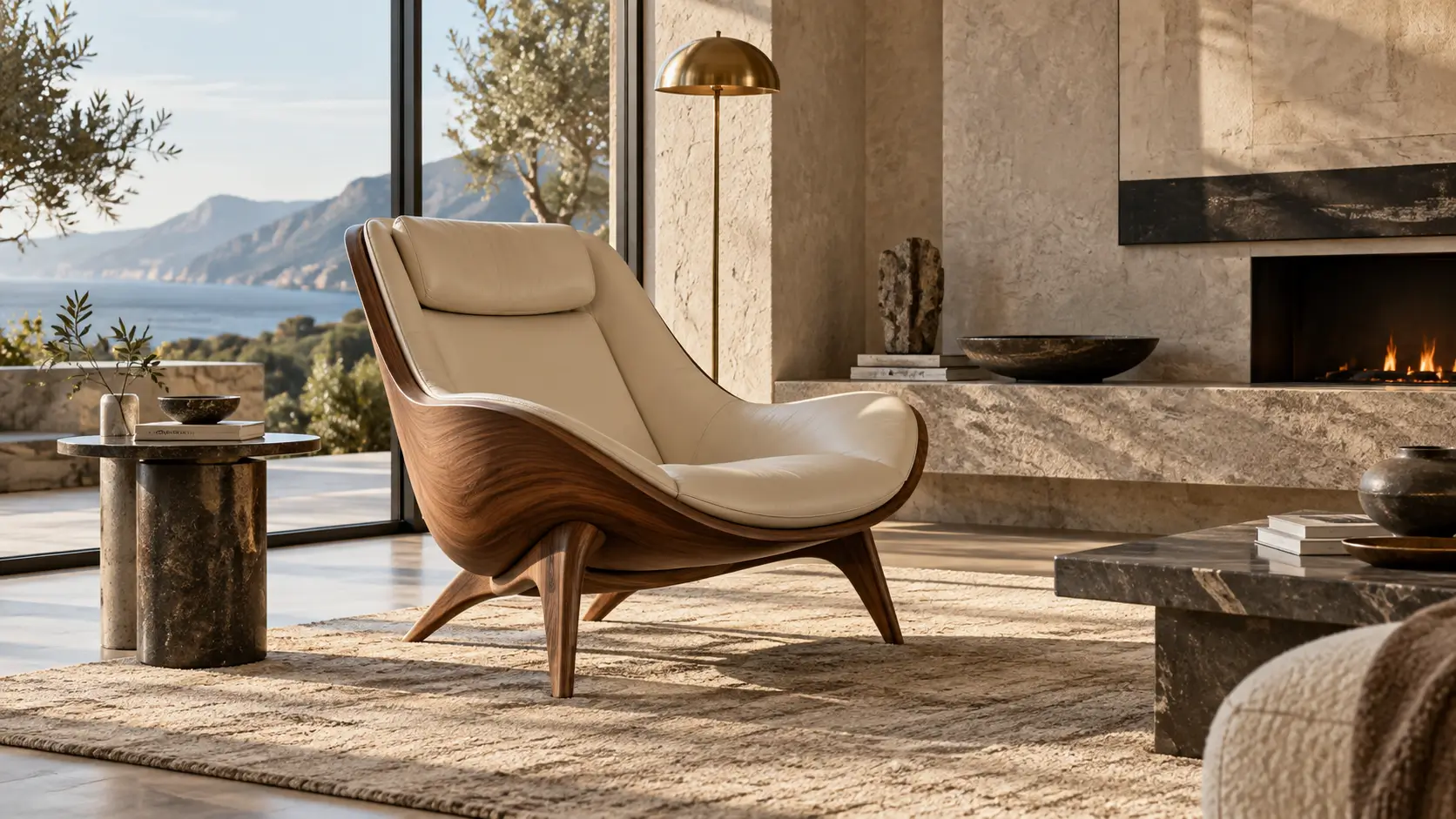
Walk into a newly built luxury home and the materials are often impeccable: limestone floors, large sheets of glass, brushed metal, carefully finished plaster and perhaps a wall of beautifully veined marble.
And yet, for all that precision, the room can still feel unfinished.
Then a low walnut chair appears in the corner. Or a deeply upholstered sofa with the relaxed proportions of the 1970s. Suddenly the room feels less like an architectural rendering and more like somewhere a person might actually want to spend an evening.
That is one of the enduring strengths of mid-century furniture. It does not need an entirely mid-century interior to make sense. In fact, some of the best examples look even better surrounded by contemporary architecture.
Decades after many of these shapes first appeared, they continue to provide something new furniture often struggles to achieve: enough personality to hold a room together without demanding all of its attention.
Mid-Century Was Modern Before “Modern” Became a Style
There is a tendency to treat mid-century furniture as a visual category: walnut, tapered legs, curved plywood, warm upholstery, perhaps an orange lamp somewhere nearby.
Its influence runs deeper than that.
Much of the furniture created during the middle decades of the twentieth century came from designers trying to rethink how people actually lived. Houses were changing. Interiors were becoming more open. Manufacturing techniques were improving. Designers experimented with moulded plywood, fibreglass, tubular steel, leather and new ways of producing furniture efficiently.
The result was not simply a particular aesthetic. It was a different way of thinking about objects.
Furniture became visually lighter. Chairs could reveal more of the floor beneath them. Tables did not necessarily need four substantial legs. Ornament became less important than proportion. Materials were often allowed to look like what they were.
Many of the things we now describe as contemporary — clean lines, open space, sculptural shapes and an emphasis on materials — were already being explored generations ago.
This is partly why a well-proportioned piece from that period rarely looks as old as its date would suggest.
A chair designed in the 1950s can sit comfortably beside a twenty-first-century concrete wall because both are speaking, in different ways, the same language of restraint.
It Brings Warmth to Architecture That Can Otherwise Feel Too Perfect
Contemporary luxury architecture has become extraordinarily good at creating calm.
Large windows dissolve boundaries between indoors and outdoors. Natural stone runs uninterrupted across floors and walls. Kitchen cabinetry disappears behind flush panels. Lighting is recessed. Technology is hidden.
The effect can be beautiful.
It can also be slightly cold.
This is where furniture becomes more than something used to fill the plan.
A walnut shell introduces grain and variation into a room dominated by smooth surfaces. Leather develops character rather than remaining perfectly uniform. Wool, bouclé and woven fabrics soften hard architectural lines. Rounded furniture introduces shapes that contrast with the grids of windows, walls and joinery.
These differences are small, but interiors are often made by small differences.
Imagine a living room finished entirely in pale limestone, glass and brushed steel. It may photograph beautifully. Add a low wooden lounge chair with generous leather upholstery and the atmosphere changes. There is suddenly an object that suggests comfort, touch and use.
The room has not become less modern. It has simply become more human.
That tension between precise architecture and expressive furniture is one of the reasons mid-century pieces continue to appear in contemporary homes.
They introduce warmth without requiring clutter.
Good Mid-Century Furniture Has a Silhouette
Some furniture is remembered because of its materials. Some because of its maker.
The best pieces are often recognisable before either becomes relevant.
You can identify them from across a room.
A curved plywood shell. A low modular sofa. A pedestal table. An exaggerated lounge chair. A seat suspended between a clearly visible frame.
They have silhouettes.
That matters particularly in contemporary interiors, where there may be relatively few pieces of furniture in a large amount of space. When a room contains only a sofa, two chairs, a coffee table and a lamp, each object has to contribute something.
Mid-century design tends to perform well in this environment because so many of its pieces were conceived three-dimensionally. They were designed to be seen from the side, from behind and across an open room rather than simply pushed against a wall.
The negative space around them can be as important as the object itself.
A chair raised on slender legs allows flooring to continue visually beneath it. A pedestal dining table removes the visual interruption of four conventional legs. A low sofa leaves more of the architecture behind it visible.
This is particularly useful in open-plan houses, where furniture often has to divide space without physically enclosing it.
A sculptural chair can mark the edge of a seating area while still allowing the eye to travel through the room.
That is a much subtler job than simply looking attractive.
The Trick Is Not to Turn the House Into a 1960s Film Set
There is, however, an easy way to make mid-century furniture look dated: use too much of it.
A walnut sideboard, teak dining set, geometric rug, vintage record player, starburst clock, orange glassware and six period lamps might create an accurate mood, but it can also make a home feel like a carefully assembled set.
The strongest contemporary interiors usually do something less literal.
They borrow from the period rather than trying to reconstruct it.
A deeply curved lounge chair might sit beside an aggressively simple stone table. A low 1970s-style sofa may face an oversized piece of contemporary art. Walnut dining chairs can work beneath a very modern pendant light. A travertine table might be surrounded by furniture from several different decades.
The contrasts keep things interesting.
It is often enough to have one or two pieces that carry a strong design language and allow everything around them to remain quieter.
This also gives furniture more room to be noticed.
A sculptural chair surrounded by equally sculptural objects has to compete for attention. Put the same chair in a restrained room and its shape becomes immediately legible.
The most convincing interiors borrow from an era; they do not cosplay it.
The Look Is No Longer Reserved for Collectors
For a long time, recreating this kind of interior presented a fairly simple choice.
You could hunt for vintage originals, accepting the compromises in condition, availability and price that come with collectible furniture. Or you could buy authorised contemporary editions, some of which now cost as much as serious works of art.
Both approaches still have their place.
A genuine vintage piece can bring history into a room in a way a new object cannot. Collecting important furniture can be every bit as rewarding as collecting watches, art or classic cars.
But not every chair needs a provenance file.
A broader market has emerged for people who appreciate twentieth-century forms without necessarily wanting to build a museum-quality collection. Contemporary makers and independent furniture retailers now offer a much wider range of pieces shaped by the proportions, materials and sculptural character associated with the period. A good example is https://madorne.com/, where the focus is on design-led furniture that can sit naturally within contemporary interiors rather than forcing the entire room into a single period aesthetic.
That shift has arguably helped mid-century design remain relevant.
Once a style becomes accessible outside the collector market, people begin using it differently.
A chair no longer has to be purchased because of the name attached to it. It can be chosen because its walnut shell works against a pale wall, because its proportions suit a reading corner or simply because someone enjoys sitting in it.
That is ultimately how most good furniture survives: by continuing to be used.
What Actually Makes a Piece Worth Living With
A photograph can tell you whether a chair is beautiful.
It tells you much less about whether you will still want it in your home five years from now.
When buying furniture with a strong mid-century influence, proportion is usually the first thing worth considering.
Many iconic lounge chairs are larger than they appear in photographs. Low sofas can look elegant in a vast room but make a smaller living space feel crowded. Conversely, furniture that is too delicate may disappear inside a large open-plan interior.
Measurements matter, but so does visual weight.
Then there are the materials.
Wood is particularly unforgiving. A beautiful grain and a carefully shaped veneer can make a simple form feel rich; a poor finish can make the same design look artificial. Upholstery matters for the same reason. Leather, wool and textured fabrics occupy large visual areas and quickly determine whether a piece feels convincing.
Construction is less glamorous but just as important.
Look at where parts meet. Pay attention to seams, edges, legs and transitions between materials. On upholstered furniture, the density and structure beneath the fabric matter far more in daily use than they do in a product photograph.
Comfort deserves consideration too.
Design history contains plenty of extraordinary chairs. Not all of them are chairs in which you would willingly spend three hours reading a book.
A piece intended for daily life has to do more than hold a good silhouette.
And finally, think about ageing.
Some of the most appealing materials in mid-century interiors are attractive precisely because they do not remain perfect. Wood develops variation. Leather creases. Metal dulls. Fabrics soften.
For a pristine showroom, that might be a disadvantage.
For a home, it is often the opposite.
Luxury Has Become Less About Newness
Perhaps the more interesting question is not why mid-century furniture has survived, but why it feels particularly appropriate now.
Luxury interiors have changed.
The obsession with everything appearing brand new has weakened. Designers increasingly combine old stone, contemporary art, vintage furniture, handmade objects and modern architecture. A room can contain an expensive new sofa and a weathered wooden stool without either looking misplaced.
There is greater appreciation for objects with character.
Mid-century furniture fits naturally into that environment because the strongest designs rarely depend on surface decoration or novelty. They depend on shape, proportion and material.
Those qualities travel well through time.
They also make furniture easier to combine with pieces from other periods.
A good walnut chair does not care whether the house around it was built in 1958 or 2026. A beautifully proportioned table does not suddenly become irrelevant because the kitchen behind it has been redesigned.
Perhaps that is the real reason these pieces continue to appear in contemporary luxury homes.
It is not nostalgia.
Nobody needs to recreate the twentieth century in order to appreciate what its best designers understood.
Furniture should be useful. Materials should have presence. A room needs contrast. And an object can have personality without shouting.
The best mid-century furniture still feels modern because those ideas never stopped being modern.
Put the right piece in the right room and it rarely looks as though it has come from the past.
More often, it looks as though everything else has finally caught up.

|
|