Before You Ring a Roofer About a Leak, Spend Five Minutes Writing This Down
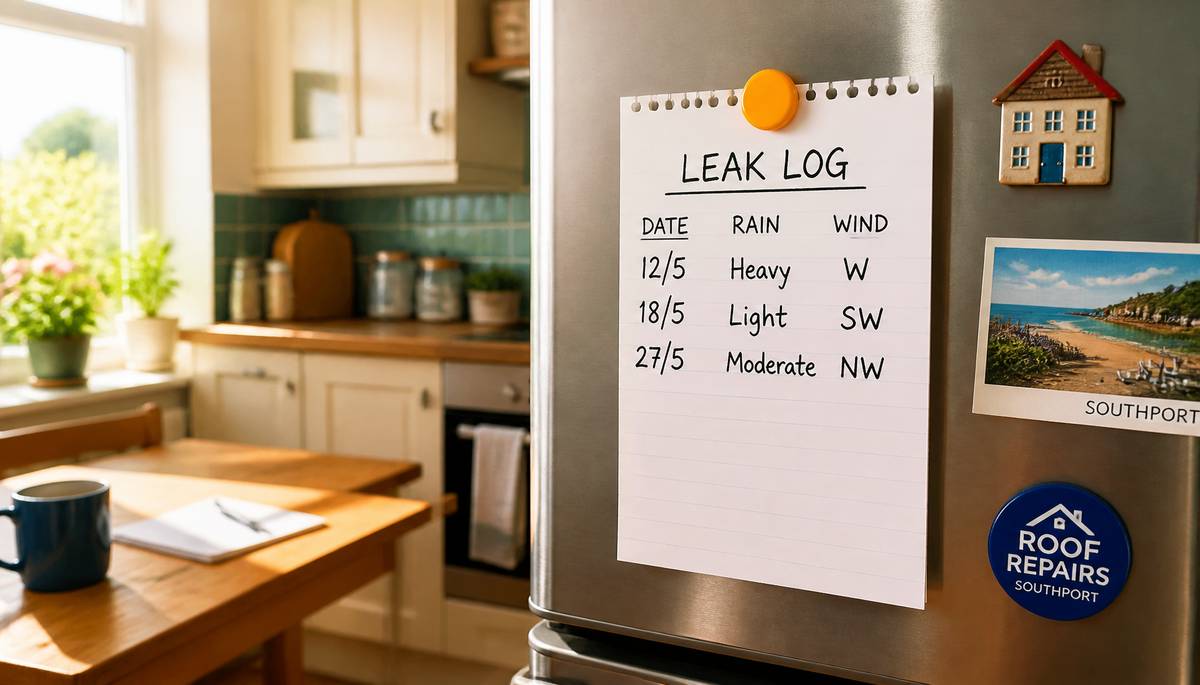 I have lost count of the number of times I have stood in somebody's spare bedroom, looked at a brown ring on the ceiling, and asked the one question nobody can ever answer.
"When does it do it?"
And the answer, almost every time, is a shrug. "When it rains?"
That shrug costs people money. Genuinely. It is the difference between a roofer who knows roughly where to look before the ladder comes off the van, and one who has to start guessing at your expense.
So here is the most useful thing I can give you, and it costs nothing. If you have a leak, get a scrap of paper and stick it on the fridge. Every time water appears, write down three things: the date, roughly how hard it was raining, and which direction the wind was coming from. Your phone's weather app will tell you the last one after the fact.
Do that three or four times and you have handed your roofer something better than a photograph.Why the pattern matters more than the puddle
The reason is a bit of physics that nobody explains to homeowners, and it catches out an enormous number of people.
The wet patch on your ceiling is very rarely underneath the hole.
Something up there lets it past. A slate off its nail. Lead that has cracked. Pointing that has crumbled out over a couple of winters. What the water meets next is not your plasterboard, though, it is the top edge of a rafter or the sagging underside of the felt, and at that point it stops falling and starts travelling.
Sometimes it runs a few inches. On a wide, low bungalow roof it can travel several metres sideways before it finds a nail or a low spot or a tear and finally drips through.
Which is how you end up with a stain in the back bedroom caused by a fault above the landing. Or one caused by something at the chimney, eight feet away and on the other side of the roof.
Now think about what a roofer does when they arrive with no information. They go up, look at the area above your stain, find whatever looks worst, and fix that. Sometimes they get lucky. Often they mend a perfectly healthy piece of roof, take the money in good faith, and three weeks later you are back on the phone to somebody else who does exactly the same thing.
That is not roofers being crooked. Most of them are not. It is roofers being asked to solve a puzzle with none of the pieces.
Your fridge note is the pieces.What the three answers actually tell us
Here is roughly how I read one.
If water only appears when the wind is coming from a particular direction, that points at something wind-driven on that side of the house. A verge, a flashing, a bit of lead that has lifted. Rain falling straight down would never get past it. Rain being thrown at it horizontally will find its way underneath and behind.
I work on the coast, so this one comes up constantly. Half the leaks I see round here behave impeccably for months and then misbehave the first time the weather swings round off the sea. People think their roof is haunted. It is just being hit from an angle it was never detailed for.
If it takes hours of steady rain before anything shows, and the direction seems not to matter, that is usually something filling up rather than something with a hole in it. A valley choked with debris. A gutter that has lost its fall. An outlet that has silted up. The roof copes fine until the volume beats it, then water backs up under the covering and comes in.
And if it drips at roughly the same rate in any weather at all, that is a genuine gap. Those are the easy ones, oddly. A real hole is far simpler to find than a detail that only fails under specific conditions.
Three different faults. Three different repairs. Three very different prices. All distinguishable from a note on your fridge.The one that is not a leak
Rule this one out before you spend a penny. It turns up far more often than people expect, and standing in the bedroom looking upwards you honestly cannot tell the two apart.
Your house makes warm damp air all day long. Showers, cooking, the kettle, washing drying on an airer, four people breathing. That air rises. If it gets into a cold loft and meets the underside of the roof, it condenses straight back into water, the same way it does on the inside of a car windscreen on an October morning.
There are tells if you know them. Condensation spreads itself thinly across a broad stretch of roof instead of gathering into one defined patch. Look for droplets clinging to the tips of the nails that poke through above you. Best clue of all is the calendar: condensation is a winter problem and disappears by May, whereas a genuine leak keeps pace with the rainfall, and rainfall does not take the summer off.
Bungalows get it worst. There is very little air in a shallow loft and almost nothing shifting it about, so whatever drifts up from the house concentrates in a way it never would under a tall Victorian pitch. I have been into no end of bungalow lofts where the felt was wet through and the roof itself was in perfectly good order.
The fix for that is airflow. Vents in the soffits, sometimes something at the ridge as well. A couple of hundred quid, usually. I have met people who had spent thousands on roofing work chasing it.What to ask whoever turns up
None of these require you to understand roofing. What matters is how comfortably they get answered.
Ask whether they are going in the loft. If there is a hatch and they do not want to look through it, they have decided to guess. The inside of a roof is where the evidence lives.
Ask them to name the fault. By the end of the conversation you want to be able to repeat it to somebody else over tea: the lead had cracked where it folds, the pointing had gone, a fixing had rusted away to nothing. "It needed sealing" names no fault at all. It only describes the thing they are planning to do next.
Ask them to explain the gap between the two positions. Somebody who has properly worked your roof out will happily trace the water's path for you, start to finish. Somebody who has not will change the subject.
And ask where you stand if it starts again. A workmanship guarantee ought to exist, ought to be on paper, and ought to be handed over without any shuffling of feet.One more thing about sealant
Every long-running leak reaches a point where somebody proposes sealant. A smear of black bitumen along a flashing, usually. Occasionally an entire roof sprayed in coating by a crew who turned up at the door without being asked.
It fails, and the reason is worth knowing. Lead expands and contracts every day of its life and eventually goes brittle where it bends. Bridging the crack leaves all that movement exactly as it was, so within a season the metal simply parts somewhere else nearby. Worse, you have now capped the outside of a roof that is still taking water in from another direction. It cannot dry. Battens rot, rafter ends turn soft, and none of it is visible until somebody strips the covering off.
One fair exception exists. Deep winter, water coming through, and the weather flatly will not allow the proper job. Buying yourself a fortnight with a temporary seal is a perfectly reasonable thing to do in that situation. Everyone just has to be honest that it is temporary, and the real repair wants a date in the diary before anybody packs up.Start the note
If you take one thing from all this, make it the fridge note.
A leak that has seen off two roofers is rarely a hard leak. It is simply one that nobody has pinned down. Pin it down and the actual fix tends to be almost insultingly minor: a new piece of lead, or a valley emptied out. An afternoon's work and a bill in the low hundreds, on the roof you have twice been told was finished.
Three dates, three rainfall guesses and three wind directions. Stick it on the fridge tonight.
Roof Repairs Southport are roof repair specialists working across Southport, Sefton and West Lancashire, with over a thousand repairs completed. They survey before they price, and they will tell you when a roof does not need the work somebody else has quoted for. More on how they trace a leak to its source at roofrepairsinsouthport.co.uk.
|
|

