Herringbone or Straight Plank? How the Laying Pattern Changes a Room
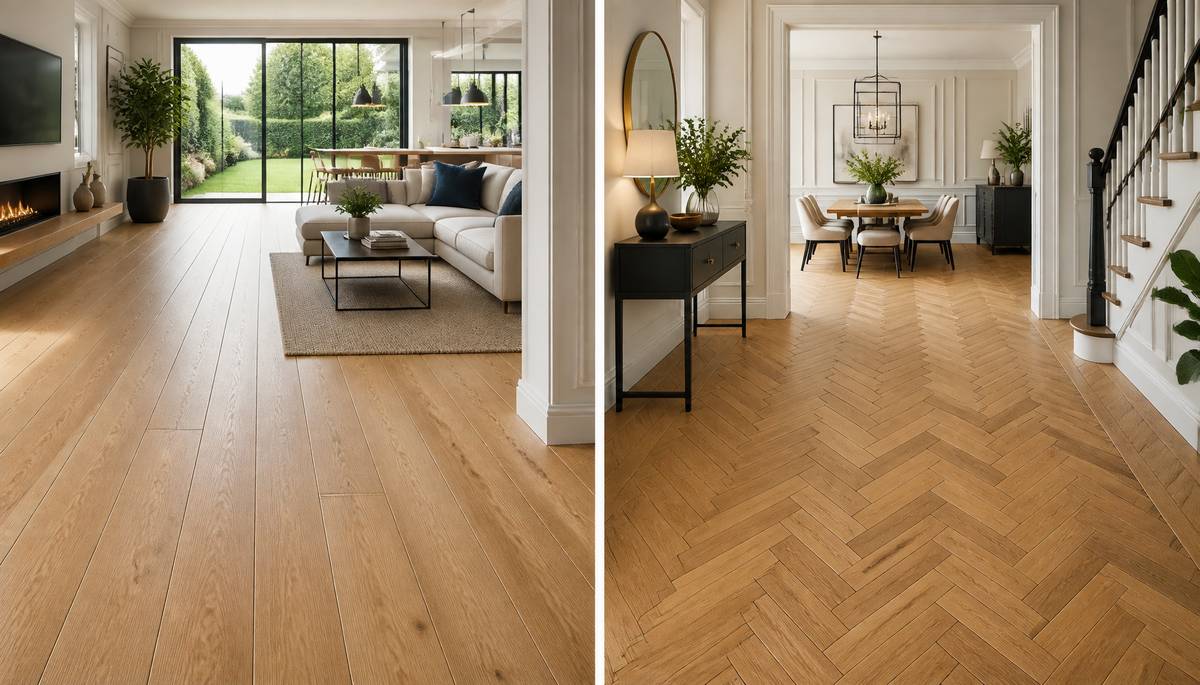 Most people choose a floor by colour. They pick a shade, order it, and only then discover there was a second decision hiding behind the first: which way the boards will be laid. That choice changes how big a room feels, how formal it looks and how much the job costs. It deserves more thought than it usually gets. Two patterns, two moods
A straight plank floor is laid in long rows, like a traditional floorboard. The eye follows the lines down the length of the room, so the space reads as calm and simple. It suits modern homes, open-plan layouts and any room where the furniture or the view should be the main event.
Herringbone uses shorter blocks laid in a zigzag. The pattern has movement, so the floor itself becomes a feature. It has been used in grand houses for centuries, which is why it still reads as smart and a little formal. In a plain room with white walls, herringbone can do the work of a rug, a feature wall and a piece of art all at once.
Neither is better. They simply do different jobs.
What pattern does to the size of a room
Lines on a floor steer the eye, and you can use that.
- Planks laid along the longest wall make a room feel longer. This is the safe choice for most living rooms.
- Planks laid across a narrow room make it feel wider. This is a useful trick in a hallway or galley kitchen.
- Herringbone points in two directions at once, so it does not stretch a room either way. Instead it adds a sense of depth. Small rooms can take it well, as long as the blocks are in scale. Very large blocks in a tiny cloakroom can look busy.
If you want one floor to run through the whole ground floor, think about the doorways. Planks should usually run the same way throughout. Herringbone can flow through doorways too, but the pattern needs to be set out from a centre line so it lands neatly in each room.
The practical differences
Waste. Every floor needs extra for cutting. With straight planks, allow around 5 to 10%. Herringbone needs more, often 10 to 15%, because every block at the edge of the room is cut at an angle.
Fitting time. Herringbone takes longer to lay. The fitter has to set out a centre line, keep the pattern square and make many more cuts. Expect the labour quote to be higher than for the same room in planks.
Subfloor. Both patterns need a flat, smooth, dry base. Herringbone is less forgiving, because a small dip can open a gap that runs along the whole zigzag.
Borders. A herringbone floor can be finished with a border of straight planks around the edge. It frames the room and tidies up awkward walls. It is optional, and it adds cost, but it is the detail that makes a floor look designed.
Mixing the two
You do not have to pick one for the whole house. A common and very effective approach is herringbone in the hallway or the dining area, where there is open floor to show it off, and straight planks in the kitchen, the utility room and upstairs. If both come from the same range and the same colour, the rooms still feel connected.
This is easier with luxury vinyl (LVT) than with real wood, because many LVT ranges offer each colour in both formats. The oak-effect Daytona LVT range, for example, comes in six shades, each available as a plank and as a herringbone block, so the two patterns can sit side by side with a perfect colour match.
How to decide
Ask yourself three questions.
- What is the star of the room? If it is the furniture, the fireplace or the garden view, choose planks. If the room is plain and needs character, choose herringbone.
- How much open floor will you actually see? A pattern hidden under a sofa, a bed and a big rug is money spent on something nobody looks at.
- What is the budget for fitting? Get the fitter to quote both ways. The difference is sometimes smaller than people fear, and sometimes it settles the question.
Finally, get samples of both formats and lay a few pieces out on the floor. Stand in the doorway, which is where you will see the room from most often. The right pattern is usually obvious within a minute.
|
|

