The Best Day to Move House: Superstitions & Stats
 For all the talk of Britain as a famously practical nation, the way the country chooses its moving days suggests something else entirely. There is the modern preference, dictated by spreadsheets, school holidays and the rhythm of the working week. And there is the older one, scribbled into folklore and rhymes that have never quite faded.
Both shape moving day decisions across the country, and both, surprisingly often, reach opposite conclusions.
First up, the stats
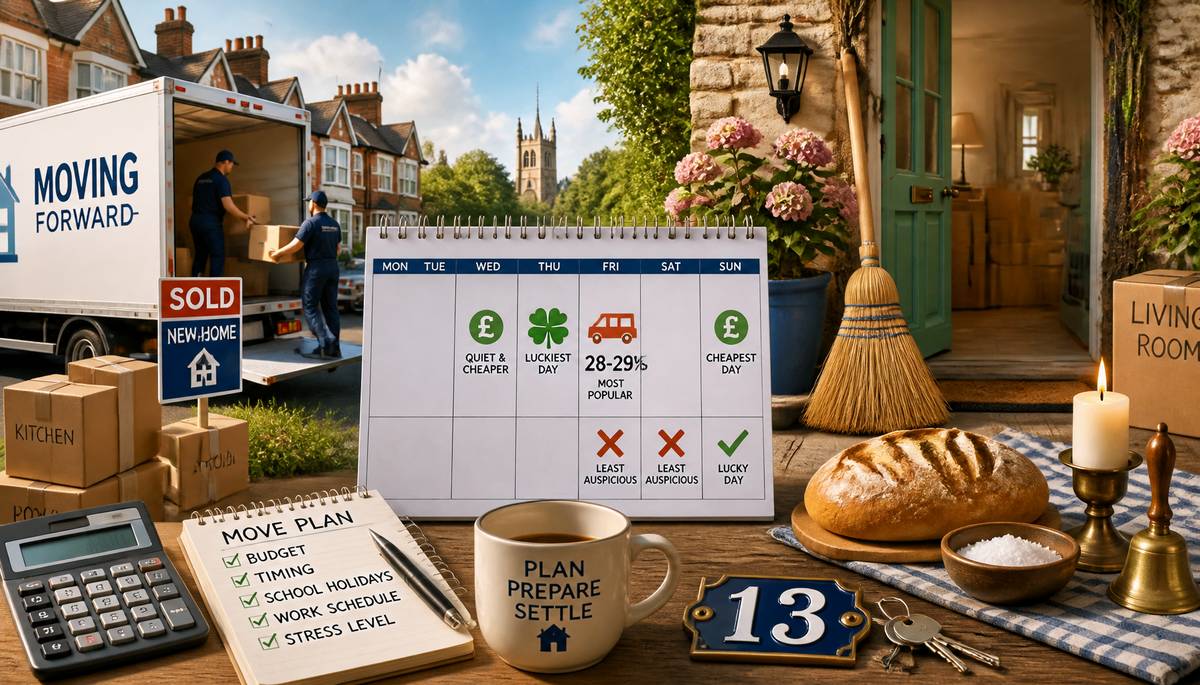
The data is unambiguous about where modern Britain lands. Analysis of more than 170,000 UK house removals shows that around 28% take place on a Friday, making it by a long stretch the most popular day for collecting keys. HomeOwners Alliance, drawing on thirteen years of removals quotes, puts the figure closer to 29%. Whichever source you trust, the verdict is the same. Britain moves on a Friday, and it has done for as long as anyone has measured.
The reasoning isn't hard to follow. A Friday move offers a clean weekend to unpack without sacrificing time off work.
Conveyancing chains have drifted into the same rhythm, so many buyers find themselves nudged towards Friday whether they chose it or not. The result is a national pile-up of completions, vans, removals teams and last-minute phone calls all aimed at the same twenty-four hours.
That pile-up has consequences. Sunday is the cheapest day to move, with an average cost of around £717. Tuesday, by contrast, is the most expensive at over £1,110, more than 50% higher. Wednesday sits in the middle as the quiet mid-week option, roughly 20% cheaper than the weekly average. One in five removal firms now openly offers mid-week discounts simply to redistribute demand. The savings are there for anyone willing to abandon the Friday habit.
There is a quieter argument against the popular choice too. Bank money transfer systems are known to struggle on the last Friday of every month, when payday and property completions collide. Estate agents are already stretched, keys are handed over later than expected, and if anything slips, the chain has no Saturday recourse. A mid-week move, by comparison, leaves a stretch of working days for any small disaster to be resolved by people who actually answer the phone.
"The day someone picks for their move often says more about their working calendar than any practical assessment of how it will run," says Currans Removals, a Manchester removals firm. "A Wednesday booking almost always feels calmer than a Friday one, because everyone in the chain still has time to react if something doesn't go to plan."
The view from older wisdom
Folklore, predictably, has its own opinion, and it isn't a flattering one for modern habits. Across a wide span of British and European tradition, Thursday emerges as the luckiest day to move into a new home. Sunday earns honourable mention too. Friday and Saturday, the two days the country now relies on most, are flagged as the least auspicious. A Lancashire rhyme captures the sentiment with rare economy: "A Saturday flit means a short sit." The implication being that anyone who moves on a Saturday won't stay long.
The rituals around the move itself stretch even further back. Brooms are not to be brought from the old house to the new one, since they are said to carry the dust and disappointments of the previous life with them. A fresh broom symbolises a clean start, an idea that maps neatly onto the feng shui principle of leaving stagnant energy behind. Bread and salt, in Jewish tradition, are the first items carried across the threshold, the bread for sustenance and the salt for permanence. Some households still ring a bell or light a candle on the first evening, a quiet inheritance from medieval beliefs about clearing residual spirits from a building.
Most of these traditions sit at the edge of memory now. They are not really followed, though they are not entirely abandoned either. Plenty of people still bring a loaf and a small packet of salt across the threshold on day one, half-jokingly, half-not. The instinct to mark a beginning seems to have outlasted the rituals themselves.
Why thirteen still loses
The clearest sign that British superstition has not fully receded comes from Rightmove. Analysis of completions data since 1995 shows that Friday the 13th is consistently the quietest Friday of the year for house moves. The thirteenth day of any month is the quietest day of the month for completions, full stop. Buyers and conveyancers are voting with their diaries, and the vote is unambiguous.
The aversion follows people into the bricks themselves. Houses numbered 13 are valued, on average, £5,521 below the typical home in Rightmove's study of more than ten million properties. House number one, by contrast, commands a premium of around £39,000. Sellers know this, buyers know this, and lenders quietly factor it in. The country has rationalised plenty of older beliefs out of its decisions, but not all of them.
Between the spreadsheet and the salt
Choosing a moving day is one of the smaller puzzles inside a much larger one. More than half of British adults rank moving house as the most stressful life event they have experienced, ahead of divorce, having a child and starting a new job. Almost a third report sleep disturbance during the process, a quarter report rows with their partner, and the average person will do it four times across their adult life. The decision about which day to book in is, in that light, not a trivial one.
For some, the right day is the cheapest one. For others, it is the day that gives the chain the most slack. For a smaller group, quietly and without making a fuss about it, it is the day the old rhymes recommend. None of these reasons is wrong. They simply reflect what each person is trying to protect on the day, whether that is the budget, the sanity, the omens, or some combination of the three.
The data and the folklore disagree, but only if you ask them the wrong question.
|
|

