Ducted Split System - Which Air Conditioning is Right for Your Home?
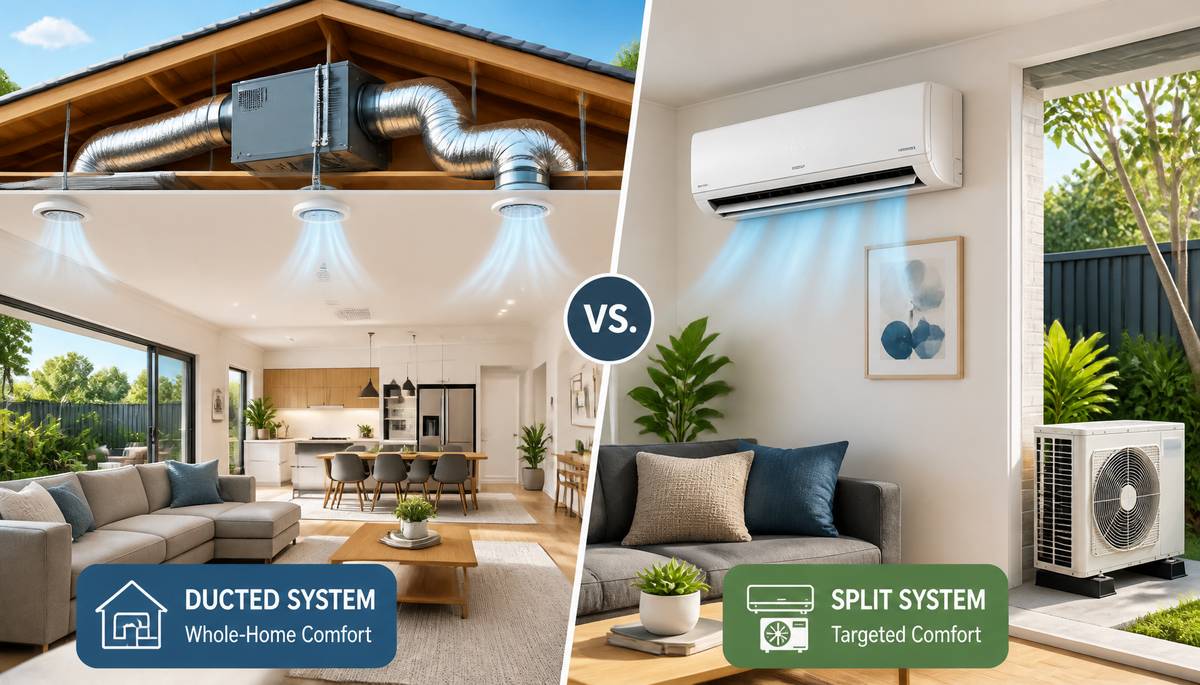
Ducted Split System: Which Air Conditioning is Right for Your Home?
Choosing between a ducted split system setup for your home can feel overwhelming, especially when both options promise comfort and efficiency. Ducted air conditioning offers whole-house cooling through hidden vents, while split systems provide targeted climate control for specific rooms. Each has distinct advantages depending on your home size, budget, and cooling needs. With this in mind, understanding the installation requirements, running costs, and practical considerations becomes essential. This guide breaks down everything you need to know about both systems to help you make an informed decision that suits your home perfectly.
Understanding Ducted and Split System Air Conditioning
What is a Ducted Air Conditioning System?
Ducted air conditioning provides climate control for multiple rooms from a centrally located unit. The system operates through a network of ducts concealed in the ceiling or underfloor space, distributing conditioned air throughout your home via strategically placed vents. The indoor unit sits hidden in your roof cavity or ceiling space, connected to flexible insulated ducting that carries cooled or heated air to individual rooms. An outdoor unit positioned outside the home houses the compressor and condenser. This setup allows you to cool or heat your entire property from one system, with most modern units offering zoning capabilities to turn different rooms on or off independently.
What is a Split System Air Conditioner?
A split system air conditioner consists of two separately installed components designed to control temperature in a single room or open-plan space. The indoor unit mounts on an internal wall and contains the evaporator coil, air filter, and fan. Outside, the compressor unit sits in a discreet location, connected to the indoor unit through insulated copper tubes and electrical cables. While single-split systems serve one room, multi-head configurations connect multiple indoor units to a single outdoor compressor, allowing climate control across several rooms without installing multiple outdoor units. Split systems work by cooling and heating one area of your home, with the indoor wall-mounted unit blowing conditioned air around the room while the outdoor unit extracts heat.
How Each System Works
Both systems operate on the refrigeration cycle principle, though they distribute air differently. Ducted systems draw air from the home through a return air grille, pass it over a refrigerant coil in the indoor unit, then distribute the cooled or heated air through ductwork to each room via ceiling vents. The outdoor unit extracts heat absorbed from indoor air during cooling and releases it outside.
Split systems circulate refrigerant between indoor and outdoor units through a closed-loop process. During cooling, the indoor evaporator coil contains cold refrigerant that absorbs heat from room air. The refrigerant changes from liquid to gas as it extracts heat, with this gas returning to the outdoor unit through suction as a low-pressure gas. The compressor pressurizes this gas, converting it to a high-pressure liquid that flows through the condenser coil where heat releases to outside air. For heating, the process reverses, with the system absorbing heat from outdoor air and releasing it indoors.
Key Components of Both Systems
Ducted systems comprise several integrated parts working together:
- Indoor unit (fan coil): Houses the evaporator coil and main fan, typically concealed in ceiling cavity
- Outdoor unit: Contains compressor and condenser, manages refrigeration cycle
- Flexible insulated ducting: Foil-wrapped tubes running through roof space
- Dampers and zone motors: Mechanical flaps that open and close to control airflow to specific zones
- Return air grille and filter: Pulls air from home back into system while filtering dust particles
- Diffusers: Release points where conditioned air enters rooms
- Thermostat: Control panel for temperature settings and zone management
Split systems feature simpler components: an indoor unit with evaporator coil and fan, an outdoor unit with compressor and condenser, refrigerant lines connecting both units, and a remote control for operation. The indoor unit includes a built-in fan that circulates air within the room, extracting heat as air blows over the coil.
Installation Requirements and Process
Ducted System Installation: What's Involved
Professional ducted installation typically requires a team of 2-4 trained technicians and spans 1 to 3 days depending on property size. The process begins with a site inspection where installers evaluate your home's layout, cooling requirements, and roof cavity accessibility. Following this assessment, custom ductwork layout gets designed to ensure even airflow throughout your home while maintaining energy efficiency.
Equipment delivery precedes the installation day, with all components including ducts, indoor and outdoor units, and vents arriving ahead of schedule. Technicians start by installing return air grilles and cutting access points in the ceiling for ductwork fitting. The indoor unit gets carefully positioned in the roof cavity, suspended from metal straps or threaded rods, while the outdoor condenser sits in a well-ventilated outdoor area. Insulated ductwork then connects to each room where discreet ceiling diffusers get fitted into the ceiling material.
Certified electricians complete all electrical wiring to meet safety codes and standards. The system undergoes thorough testing and commissioning, verifying airflow rates, operating in both cooling and heating modes, testing zoning controls, and confirming temperature regulation throughout your space.
Split System Installation: Steps and Timeline
A standard split system installation takes 3 to 6 hours with a team of two trained professionals. Installers mount the indoor unit bracket on an external wall at approximately 7 feet off the floor, ensuring at least 6-12 inches of open space on every side for proper airflow. They drill a circular hole through the wall, sloping slightly downward for adequate drainage.
Refrigerant pipes, power cables, and drain pipes get secured together with electrical tape and run through the wall opening. The outdoor unit gets positioned on a concrete pad or wall brackets within 50 feet of the indoor unit, secured with anchor bolts on a rubber cushion to minimize vibration. Installers connect the copper refrigerant piping using flare nuts and establish electrical connections between both units. A vacuum pump removes air and moisture from the system before releasing refrigerant. Final testing verifies proper operation, drainage, airflow, and temperature performance.
Ceiling Space and Structural Requirements
Ducted systems demand adequate roof space for both the central unit and ductwork. Ducts generally measure between 200mm and 400mm in diameter, requiring sufficient clearance between the roof and unit for safety reasons. Roof trusses may need alteration or complete removal to fit the air conditioning unit, necessitating consultation with builders and engineers to preserve roof integrity.
Homes with raked ceilings face installation challenges since ducts cannot be laid over these high ceilings. Properties with no roof cavity can use bulkhead ducted systems, where ductwork gets concealed within drop ceilings or bulkhead structures, though this permanently lowers ceiling heights.
Best Time to Install Each System
Autumn emerges as the optimal installation period, with easing temperatures and greater installer flexibility. Winter also works well for planning installations before summer heat returns. Avoid peak summer months when installers face heavy demand, longer wait times, and higher prices.
Energy Efficiency Ratings and Performance
Reverse-cycle air conditioners achieve 300% to 600% energy efficiency because they transfer heat rather than generate it. For every kilowatt of electricity consumed, these systems produce three or more kilowatts of heating or cooling capacity. Star ratings directly impact long-term costs. Each additional star can reduce running costs by up to 10%.
Split systems generally demonstrate superior efficiency when cooling individual spaces. Ducted systems lose efficiency through ductwork and require larger fans, making them more expensive to run despite meeting minimum energy performance standards.
Zoning Capabilities and Cost Savings
Zoning technology delivers measurable savings by conditioning only occupied areas. Studies show zoned systems cut HVAC energy consumption by 20% to 30% compared with single-zone operation. The U.S. Department of Energy estimates zoning saves homeowners up to 30% on typical heating and cooling bills.
Design, Esthetics, and Practical Considerations
Indoor Unit Appearance and Placement
Visual impact separates these systems dramatically. Ducted installations achieve minimal visual intrusion with flush ceiling vents and concealed ductwork, offering clean lines that complement modern interiors. Split systems remain visible on walls, though contemporary units feature slimmer profiles and neutral tones that blend into most rooms. Multiple wall-mounted units in open-plan spaces can detract from esthetics. For split system placement, install indoor units high on exterior walls near the ceiling with 15cm clearance on each side. Position units centrally within the space for even air distribution. Outdoor units require shaded locations with adequate ventilation, away from trees and mounted on stable surfaces.
Noise Levels During Operation
Modern air conditioners average around 35 dBA, with premium models reaching as low as 22 dBA. Some units feature silent modes that reduce operation to 24 dBA, barely louder than rustling leaves. Split systems generally produce more operational noise than ducted systems, particularly when multiple units run simultaneously. Ducted systems benefit from central placement with components hidden in roof spaces, minimizing audible disruption.
Maintenance Requirements for Each System
Split systems offer straightforward filter maintenance. Homeowners can remove, clean, and replace filters without professional assistance. Filters need cleaning monthly during heavy use or every three months for moderate operation. Ducted systems require yearly professional servicing. Technicians inspect roof components, clean ducts, and address blockages that reduce efficiency. In light of their construction, well-maintained split systems last 10 to 15 years while ducted systems extend to 15 to 20 years.
Which Air Conditioning System is Right for Your Home?
Best Choice for Large Homes vs Small Spaces
Split systems excel for cooling one to two rooms, making them ideal for smaller homes, apartments, and targeted comfort zones. Ducted systems suit medium to large homes requiring whole-house coverage, particularly properties with three or more rooms needing simultaneous climate control. When a large home needs four or five split system heads, ducted installations often prove more cost-effective.
New Build vs Renovation Considerations
New construction provides the optimal opportunity for ducted installation since ductwork integrates seamlessly during the building phase. Renovations face complications due to limited ceiling access and potential structural modifications. Split systems offer practical alternatives for existing homes where retrofitting ducts proves invasive or impractical.
Climate and Usage Pattern Factors
Local climate significantly influences system selection. Humid regions require units with active moisture management capabilities. Your usage habits matter equally. Cooling only living areas during the day and bedrooms at night suits zoned ducted systems, while heating or cooling a single space makes split systems more efficient.
Budget-Based Decision Making
Upfront costs favor split systems for limited budgets, particularly when cooling requirements span only one or two rooms. However, ducted systems deliver better long-term value for larger properties where multiple split units would accumulate comparable expenses.
Room-by-Room vs Whole-House Cooling Needs
Room-by-room temperature control suits families with varying comfort preferences, achievable through multiple split systems or zoned ducted configurations. Whole-house comfort seeking consistent temperatures throughout benefits most from ducted installations.
Professional Assessment and Consultation
Professional evaluation removes guesswork from system selection. Qualified installers assess your property layout, calculate required capacity based on room dimensions and insulation quality, evaluate ceiling space availability, and recommend appropriately sized equipment. This ensures optimal performance while preventing costly undersizing or oversizing mistakes.
Figuring Out What is Right for Your Home
The ducted versus split system debate comes down to your specific circumstances rather than one clear winner. Split systems offer affordability and flexibility for smaller spaces or targeted cooling, while ducted installations provide whole-house comfort with cleaner esthetics.
Your budget, property size, and cooling needs should guide the decision. On balance, split systems work best for apartments and modest homes with limited budgets. Ducted systems suit larger properties where whole-house climate control justifies the investment.
Whichever system you choose, professional assessment ensures proper sizing and installation. This investment in expert consultation prevents costly mistakes and maximizes long-term comfort and efficiency.
|
|

