Why the Best Garden Designers Look Outward, Not Inward
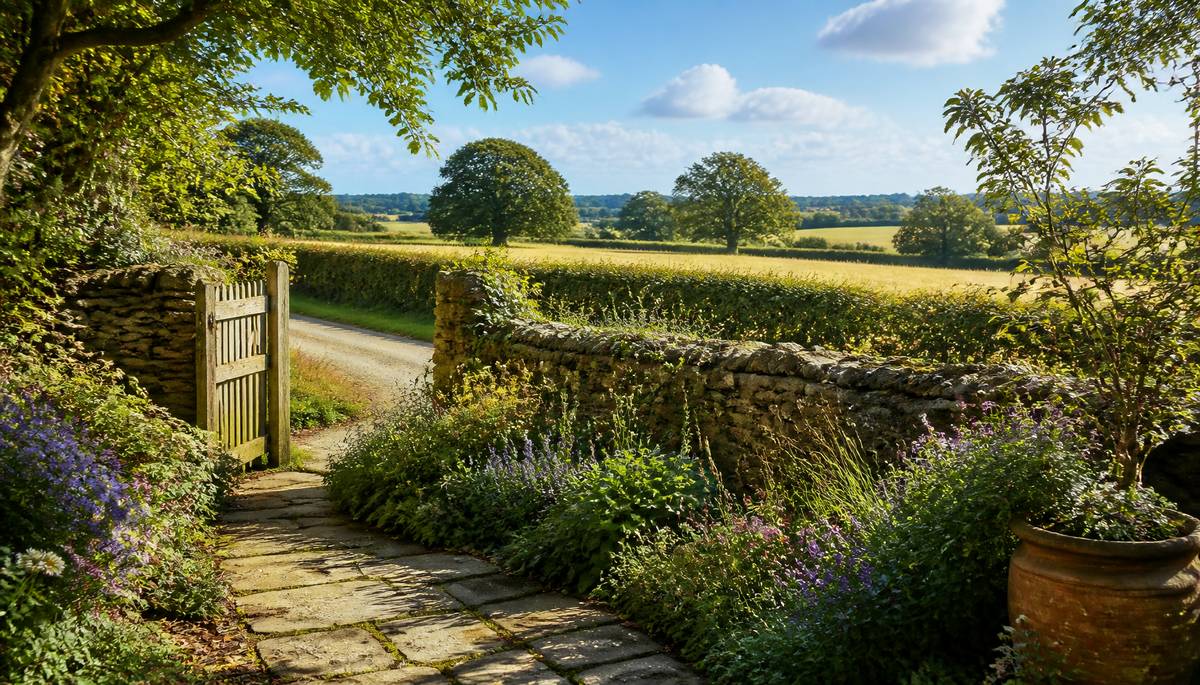 There is a particular feeling that comes from standing in a garden that seems to have always been there.
Not finished, not styled, not curated, but settled.
The hedge follows the line of the field beyond it. The stone underfoot matches the wall at the bottom of the lane. The planting catches the light in the same way the meadow at the edge of the village does in late August.
Nothing announces itself, and that is precisely the point.
For most of the last decade, the conversation in residential garden design has pulled in the opposite direction.
Outdoor kitchens, porcelain paving, sculptural fire pits, sprung-cushion sofas dressed in linen and brought in each night by some long-suffering homeowner.
The garden as another room of the house, an extension of the interior in language, materials and intention.
It looked good in photographs. It often looked very strange in the rain.
Something has shifted, though, in the way designers and clients are talking about gardens. The language has moved away from staging and styling, and towards permanence, weathering and ecological response.
Landscapes are increasingly described as inseparable from their geography, shaped by where they are rather than imposed upon it. It is the language of context, and it is starting to displace the language of decoration.
What Contextual Design Actually Involves
In practical terms, designing with context means starting with the site rather than the brief.
It means walking the land in different weathers, noting where the wind comes from and where the water gathers. It means looking beyond the garden’s boundary at the hedgerows, the field patterns, the local building stone and the trees that have been there long enough to have shaped the soil beneath them.
It also means resisting some of the more obvious impulses.
The cottage garden look in a contemporary Cotswolds new-build is rarely contextual, however charming the planting list. Equally, an austere minimalist scheme in a Lincolnshire farmhouse is not contextual just because it uses local limestone.
Context is a question of fit, and fit is harder to fake than aesthetics.
“Every design decision is rooted in the local landscape,” explains Mark Wright from Umber Garden Design, a designer and landscaper based in Warwickshire. “We favour materials that age gracefully, planting that supports pollinators, and layouts that respond to how people naturally move through space. The result is a garden that feels effortless, timeless rather than styled.”
A Return to Genius Loci
The notion is not new.
English garden design has carried it for the better part of three hundred years, ever since the eighteenth century philosophers and landscape gardeners borrowed the Latin phrase genius loci, the spirit of the place, and made it the organising principle of the picturesque movement.
The great landscape gardens of that era were not invented from scratch. They were responses to the land they sat in, conversations between water, woodland and the long English horizon.
What is interesting now is not that this idea has reappeared, but where it has reappeared.
Not in heritage circles or academic landscape architecture, where it never really left, but in the everyday vocabulary of designers and clients planning new gardens.
The clients commissioning gardens now are, on the whole, less interested in the showpiece reveal and more interested in something they describe with words like calm, grounding and rooted.
They want a garden that will mean something in twenty years rather than look striking on completion.
The Trouble with the Styled Garden
The dominant garden of the last fifteen years was the styled garden.
It had a defined palette, a strict material vocabulary, often a single accent colour repeated in cushions and planters.
It looked complete on the day it was photographed and steadily worse with every passing season as the planting outgrew its allotted slot, the render stained, the porcelain settled unevenly and the cushions faded.
A contextual garden has the opposite trajectory.
It looks tentative on day one, sometimes a little raw, because the planting has not knitted together yet and the stone has not weathered.
Three years in, it starts to feel coherent. At ten years it begins to look as if it could not have been any other way. At twenty it is hard to imagine the site without it.
The materials chosen for context tend to be the ones that improve with age.
Stone with a bit of grain. Brick that absorbs lichen rather than repelling it. Timber that silvers. Native hedging that thickens slowly into something birds will nest in.
None of these things make for a striking before-and-after on social media.
All of them make for a garden you would actually want to live with.
Designing for the Long Quiet
The deeper appeal of contextual design, and the reason it is gaining ground now rather than at some earlier moment, is probably to do with how exhausting the styled approach has become.
Constant maintenance to preserve a finished state. Constant updating to keep up with the next trend. Constant low-level anxiety that the garden is not quite right.
A garden that belongs to its place is, by definition, beyond the trend cycle.
It is anchored in something older and steadier than fashion: the local geology, the regional flora, the way the light moves across a particular piece of England in November.
That kind of anchoring is not stylish, exactly.
It is something better than stylish.
It is the quiet certainty of a space that knows where it is.
That feels like the right ambition for the gardens we are building now.
Less performance, more belonging. Less reveal, more residence.
The trend forecasts can have their saunas and their travertine.
The gardens that will still be worth standing in twenty years from now are the ones being designed to look as if they have always been there.
|
|

