homeandgardenlistings
A comprehensive website review service for home and garden-related businesses
★ Get your own unique FAQ + Selling Points on your profile page
★ be seen by 1000s of daily visitors and win new business
homeandgardenlistings.co.uk Miniblog
Why Is Lowe's Delivering Soap And Tape By Drone?
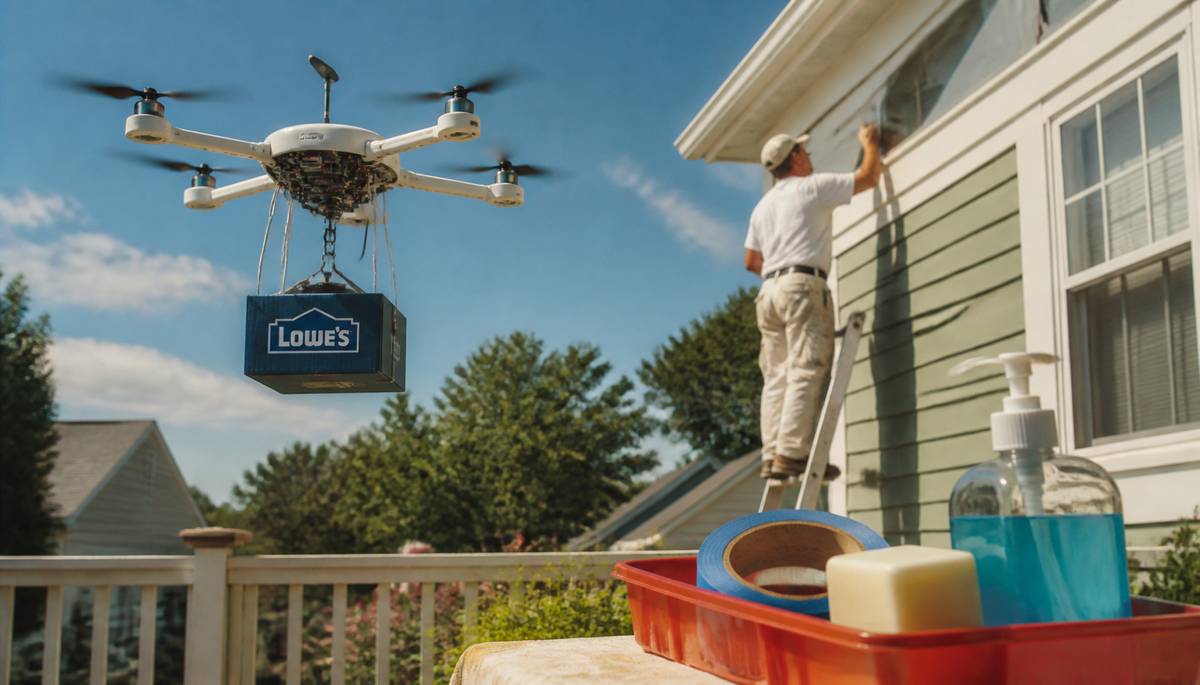 Lowe’s is now sending soap, tape and other small household fixers through the air by drone, which sounds faintly absurd until you remember how many jobs are derailed by one missing item. Halfway through painting a wall, up a ladder, or stuck on a job site, the absent roll of tape suddenly becomes the whole story.
The retailer has launched a pilot in Matthews, North Carolina, near Charlotte, making it the first home-improvement chain to try this sort of delivery. Orders are placed through DoorDash, with Wing handling the aircraft, and qualifying customers can receive selected items in as little as 20 minutes.
There are limits, naturally. The drones carry loads of about 2.5 pounds, so this is not about flying sheets of plasterboard across suburbia. It is aimed at the nagging essentials: hand tools, paint supplies, batteries, all-purpose cleaner, soap. The bits people forget because they are ordinary, yet indispensable once the work has begun.
Lowe’s is folding the trial into its wider push on faster fulfilment, alongside click-and-collect, kerbside pickup and same-day delivery. The company says the point is simple enough: remove friction from home improvement. Fair. If a drone can save a wasted journey for a bar of soap and a roll of tape, that is not futuristic fantasy. It is retail attending to irritation with unusual precision.
Posted on 25 September 2026
The Real Reason Your 1930s Storage Feels So Useless
 Your 1930s cupboards are not failing you. They were simply built for another life.
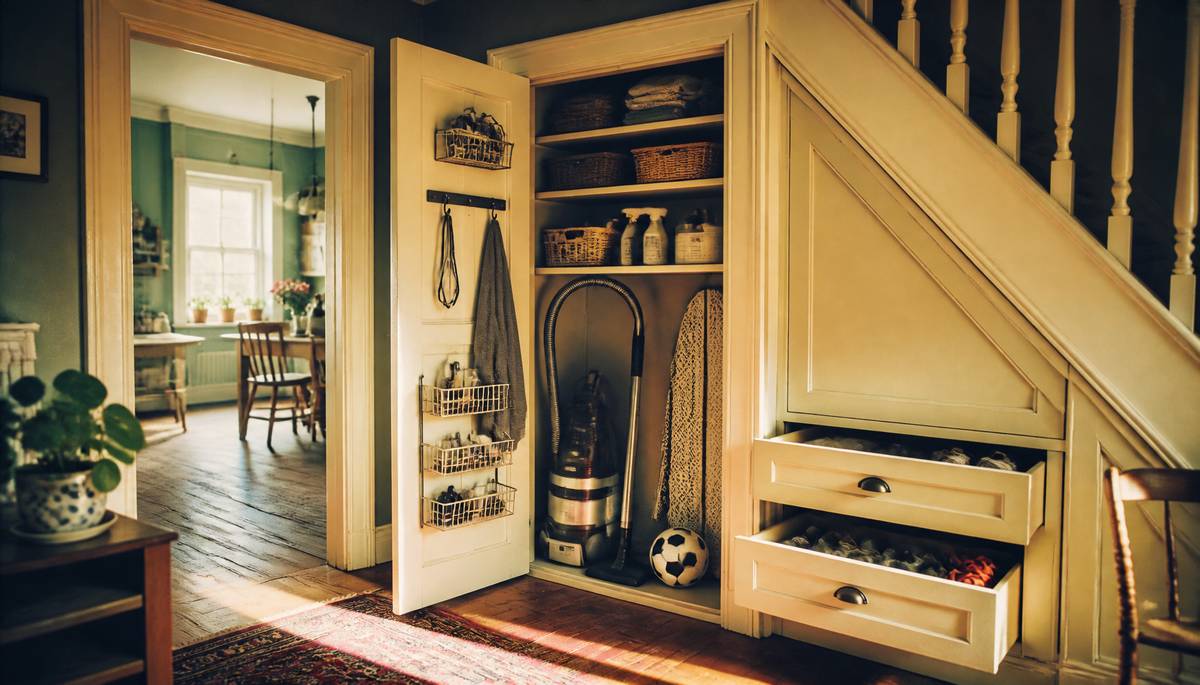
A house from that period often has plenty of storage on paper, yet nowhere sensible for the things people actually own now. The original layout assumed fewer clothes, fewer gadgets, fewer cleaning tools, and almost none of the awkward domestic machinery that now seems to breed in hallways and utility corners. A neat coat cupboard once held boots and outerwear. Now it is somehow meant to absorb a vacuum, an ironing board, sports kit, a router, and a nest of old charging cables.
The problem is less shortage than mismatch.
That is why the answer is often not major building work but a sharper use of what is already there. Alcoves can take fitted shelves or cupboards beautifully, especially where freestanding furniture always looked slightly wrong. The void under the stairs can become drawers, shoe storage or proper shelving instead of a dim holding pen for umbrellas and a dead mop.
Inside cupboards, the waste is usually vertical. Add shelves, baskets, hooks or racks fixed to the back of doors, and they start behaving differently. Then use furniture with concealed storage: window seats, beds with drawers, wall-mounted cabinets.
The trick is simple enough. Keep everyday things easy to reach. Hide luggage and Christmas decorations higher up. The house was planned for 1936. Your job is to persuade it to accept the air fryer.
Posted on 20 September 2026
Making Better Use of Vertical Space at Home
 You can spend a small fortune on clever storage, then completely ignore the great unused continent hovering just under the ceiling. It’s absurd, really. We fret about square footage while whole strips of wall sit there doing absolutely nothing.
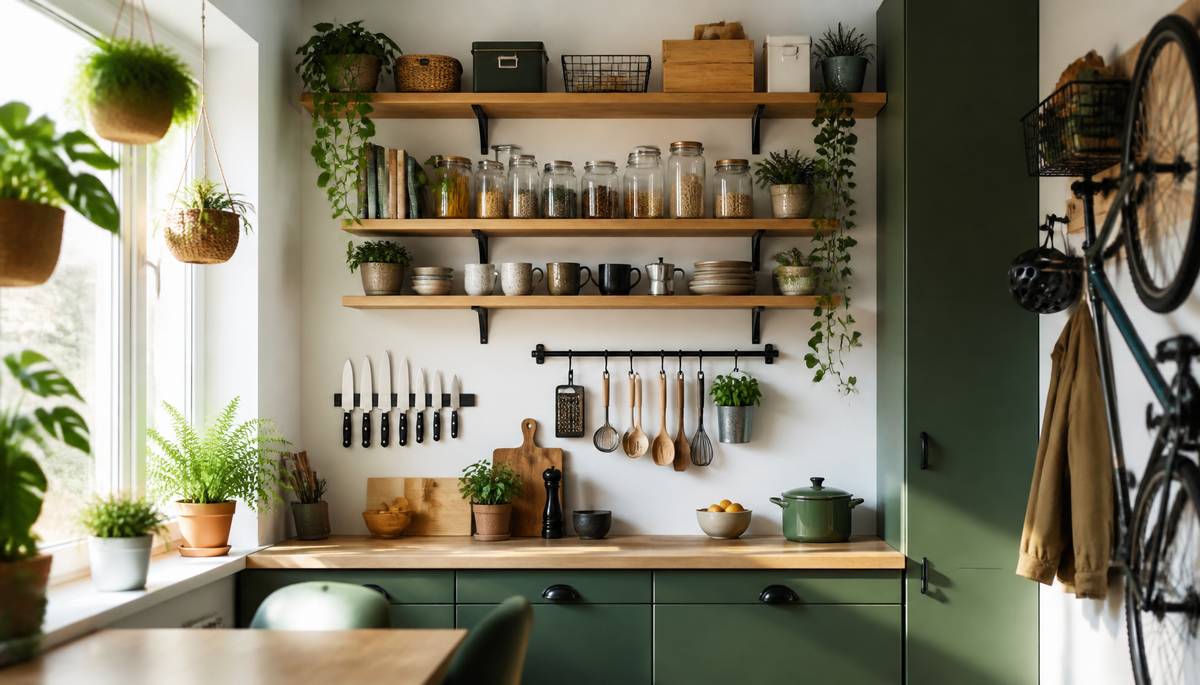
The obvious fix is height. Shelving and bookcases that run upwards, not just outwards, can swallow a surprising amount. Keep daily bits at arm’s reach and banish the awkward, occasional, once-a-year items to the top shelves. Use decent boxes or baskets and it looks purposeful rather than like a stockroom with ambitions.
Walls can work much harder, too. A desk that folds away, a slim bedside shelf, a wall-mounted television unit or drop-leaf table all free up floor space, and in a small room a few extra clear inches can make the place feel calmer almost instantly.
Kitchens are particularly ripe for this sort of thinking. Rails, hooks, magnetic strips and tall cupboards can lift utensils and equipment off the worktop, which is where clutter goes to breed. The same principle works in halls, garages and utility rooms, with wall storage for bikes, coats or cleaning gear.
Even plants can be persuaded skywards with hanging baskets, climbers and wall planters.
The only catch is common sense: heavy things need secure fixings, and the stuff you use every day should not require a stepladder. Your home won’t get bigger. It will just finally start using the space it already had.
Posted on 14 September 2026
Why Is The Darkest Corner Of Your Garden Often The Most Atmospheric?
 That dim little patch by the fence? It may not be the problem child of the garden. It might be the bit with actual personality.
Shade has its own rules, so the trick is to stop treating it like a sun border that’s being difficult on purpose. A spot that gets a little morning light is one thing; bone-dry soil under a big tree is quite another. Watch it properly. Notice when the sun reaches it, if at all, and how long the soil stays damp. That tells you what will cope.
This is where foliage really earns its keep. Ferns bring detail and movement, hostas add those big theatrical leaves, and hellebores, heucheras and some hardy geraniums can layer in extra colour and texture without looking like they’re trying too hard.
Shady areas are especially good for a woodland feel. Mix heights so shrubs sit behind lower plants, then add logs, stones or a curving path to make the space feel intentional rather than abandoned. Handy bonus: those features can also help insects and other wildlife.
And if the ground is awkward, use containers. Pots let you improve the compost in one small area and shift things around as the seasons change.
Honestly, the darkest corner often feels the most atmospheric because it’s cooler, quieter and slightly hidden. Not a failure. More of a mood.
Posted on 8 September 2026
Why Is Home Depot Betting 2,000 Stores Can Beat the Warehouse Model?
 Amazon built warehouses the size of minor planets and told us that was the future. Home Depot is trying a different trick: use more than 2,000 shops already sitting in neighbourhoods across America and turn them into mini-fulfilment bases. It’s a practical sort of rebellion.
Its new nationwide Express Delivery service promises thousands of items in three hours or less for a small flat fee, with no membership attached. That matters. Tradespeople do not want a loyalty cult; they want adhesives, caulk, pipe fittings, paint and tools to appear before the plaster sets and everyone starts swearing.
The bet is simple enough. A warehouse can be efficient, but a local store is already close to the customer and already stocked with the things people suddenly discover they’re missing. One more bag of fertiliser. A replacement part. Electrical bits. Everyday project supplies. Home Depot is banking on proximity beating centralisation for urgent orders.
This doesn’t replace its wider logistics network; it complements it. Orders over $25 can still qualify for free same-day delivery if placed by 4 p.m. Its delivery centres already get more than 65% of in-stock parcel items to customers the same day or next day, while about 55% of in-stock bulky orders arrive within two days. Next-day appliance delivery now reaches 60% of the US on key models.
The clever part isn’t speed alone. It’s using the store as the warehouse.
Posted on 31 August 2026
The 30% Rule That Can Save You From a Renovation Nightmare
 Summer is when rogue builders bloom. The weather improves, household irritations become impossible to ignore, and suddenly the man with the dazzling Instagram feed and a suspiciously cheap quote appears at your gate like a suburban Mephistopheles.
The simplest protection is the 30% rule: be wary of any contractor asking for more than roughly a third of the total cost upfront. In most cases, deposits sit between 10% and 30%. A higher figure can occasionally be justified for small jobs or bespoke materials, but it should be clearly itemised and properly explained.
The danger is not theoretical. In 2024, Americans reported 81,925 home improvement scams, with a median loss of $1,800. Nearly one in 10 people has been caught by one. Some lose far more. One Texas family reportedly spent $250,000, ended up bankrupt, and were left living in a camper after hiring a couple who posed as professionals online.
Other warning signs are pleasingly consistent: demands for cash or prepaid cards, pressure to use a “friendly” lender, refusal to show a licence or insurance, shoddy work followed by fresh charges, and quotes far below everyone else’s.
Check the contractor against your state’s licensing database. Ask for a certificate of insurance. Look them up with the BBB. Get several quotes. And if a bargain feels too charming to be true, it almost certainly is. Posted on 25 August 2026
The Housing Slump's Quietest Casualty: Postponed Renovations
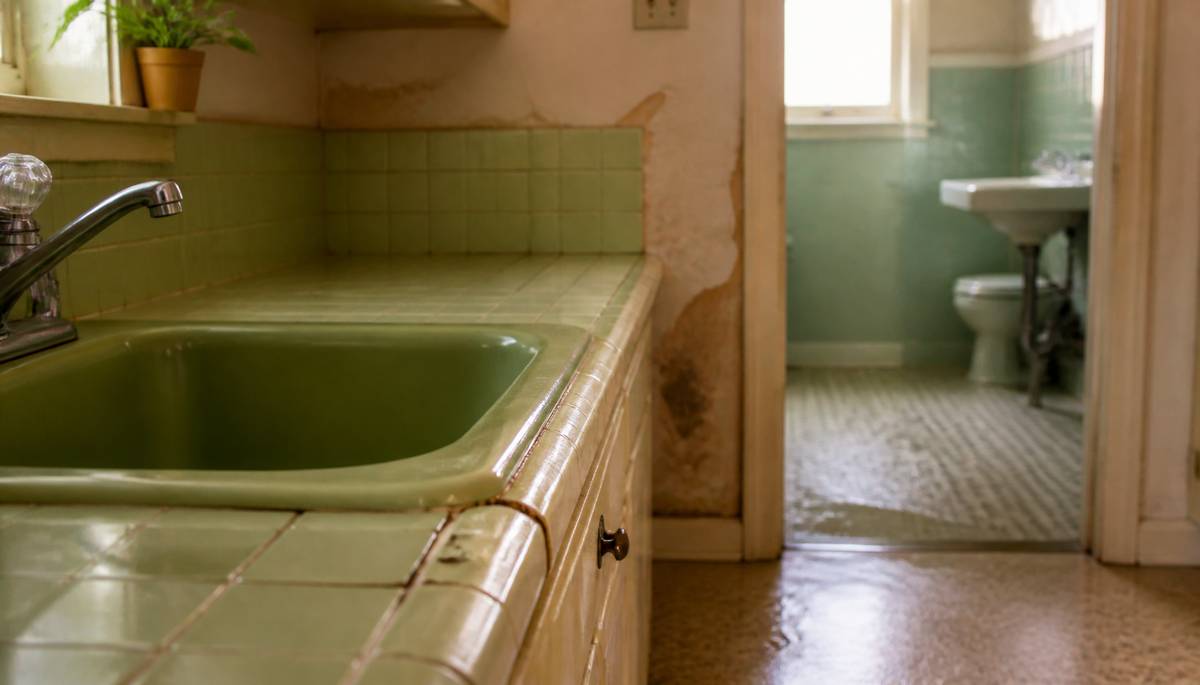 The most revealing sign of a housing slowdown is not a For Sale board that never comes down. It is the kitchen that stays avocado-green for another year, the bathroom that continues to leak its mild despair into the grout. Deferred renovation is the recession in mufti: less dramatic than a repossession, but no less telling.
That is why this week’s numbers from Home Depot and Lowe’s matter. Home Depot reports on Tuesday, with analysts looking for roughly $47.2 billion in quarterly revenue; Lowe’s follows on Wednesday, expected at about $26.1 billion. The real scrutiny, though, will fall on comparable-store sales. A flicker of growth would hint that homeowners are finally loosening their grip on the purse. Another slide, and the suspicion hardens that big-ticket DIY remains in the deep freeze.
Investors have already shown their preferences. Lowe’s shares have fallen far more than Home Depot’s in 2026, suggesting less faith in its ability to ride out the slowdown.
Yet the story is wider than plywood and power drills. Results from Target, TJX and Ross Stores, with Walmart still to come, should show whether consumers are actually retreating or merely editing their desires. That distinction is crucial. Trading down can flatter discounters while bruising retailers tied to optional spending.
The question is not whether people are buying. It is what they can still bear to put off.
Posted on 18 August 2026
The Pro Shopper May Be Saving Lowe's
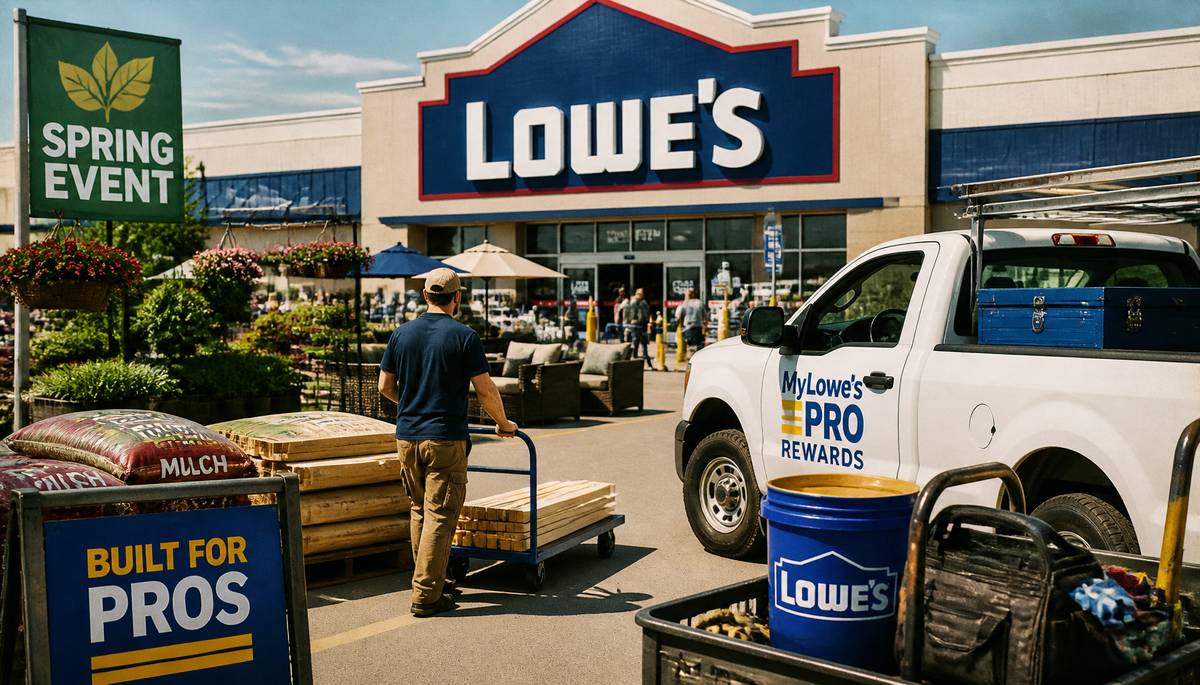 Lowe’s is finding money where the mood is lousy. The housing market is soft, DIY shoppers are hesitant, and people are not exactly skipping into a store to buy mulch and optimism. Yet the retailer still managed a solid first quarter, and the pro customer looks like a big reason why.
Net sales rose just over 10% to $23.1 billion. Comparable sales edged up 0.6%. Online sales jumped nearly 16%. Operating income improved to $2.6 billion from $2.5 billion, while net income held basically steady at $1.6 billion. In a shaky home improvement market, that is not glamorous, but it is sturdy. Very sturdy.
Spring did a lot of the lifting. Lowe’s said its seasonal event boosted demand for live goods, landscaping products, hardscapes and patio furniture, while nine of 13 merchandising categories posted positive comparable sales, including appliances, paint, electrical and millwork.
But the more interesting story is the tradesperson. While DIY remains under pressure, pro comparable sales were positive, helped by the MyLowe’s Pro Rewards scheme. That matters because Home Depot has long been the default for professionals, and Lowe’s is clearly trying to change that habit.
It is also chasing younger shoppers with partnerships like MrBeast and Dad Social, hoping to shift loyalties early. For the full year, Lowe’s expects sales growth of 7% to 9%, with revenue reaching as much as $94 billion.
Posted on 13 August 2026
The 40-Year-Old First-Time Buyer Is Reshaping The Housing Market
 The typical first-time buyer is no longer thirty and full of hopeful compromise. In 2025, the median age hit 40, up from 30 in the early 1990s, and that shift is changing not just who buys, but what they buy and what they do next.
Millennials, now aged 30 to 45, are spending more on home projects than any other group. Angi’s 2025 figures put their average annual outlay at $14,199, ahead of Gen X at $12,956 and Baby Boomers at $12,454. Boomers still spend the most on pure improvements, but millennials lead overall because they are pouring money into upkeep, urgent repairs and homes that need work.
It makes sense. Prices have outrun incomes, mortgage rates have made moving less attractive, and nearly three-quarters of younger owners say rates are pushing them to stay put and improve what they have. Meanwhile, searches for fixer-uppers have more than tripled in four years.
This is a practical generation, but not an unromantic one. They want efficient layouts, durable materials, smart appliances, natural wood, concealed storage, better outdoor space. A house, but edited.
For sellers, the message is plain: tired flooring, peeling paint and neglected maintenance now read as expense, not charm. For buyers, the 40-year-old first purchase is increasingly not a finished home, but a project with promise.
Posted on 8 August 2026
Why Did Home Improvement Leads Fall Off So Fast In Q2?
 Home improvement leads didn’t vanish in Q2, but they lost their swagger fast. The market is still growing, just with more doubt in the air.
The latest US Remodeler Index shows home improvement specialists — the firms selling roofs, windows, siding, decking and bathroom refits — dropped to 62 in Q2 from 69 in Q1. That still signals expansion, since anything above 50 means the sector is moving forward. But the slide matters. So does the mood change: near-term sentiment sank 13 points after a very upbeat start to the year.
The sharpest warning light was lead flow. Only 25% of firms said enquiries were running above normal, down from 38% in Q1. At the same time, 45% said leads were below normal. Backlogs averaged just 3.0 months, which is not much shelter if fresh enquiries stay patchy.
Demand hasn’t collapsed. It has cooled. The demand reading slipped from 60 to 55, moving from strong into merely normal territory, while current activity eased from 68 to 62. Completions were still 3% higher than a year ago, but growth is slowing.
Why the drop-off? Mainly shaky consumers. More than half of pros cited uncertainty, with buyers taking longer, collecting extra quotes, trimming project scope or opting for cheaper bids. Higher rates, labour shortages, material costs and fiercer competition all added drag. Revenue growth expectations for 2026 have now been cut from 9% to 4%.
Posted on 31 July 2026
The Real Shock Is Not The Color Change - It's The Carpet Effect
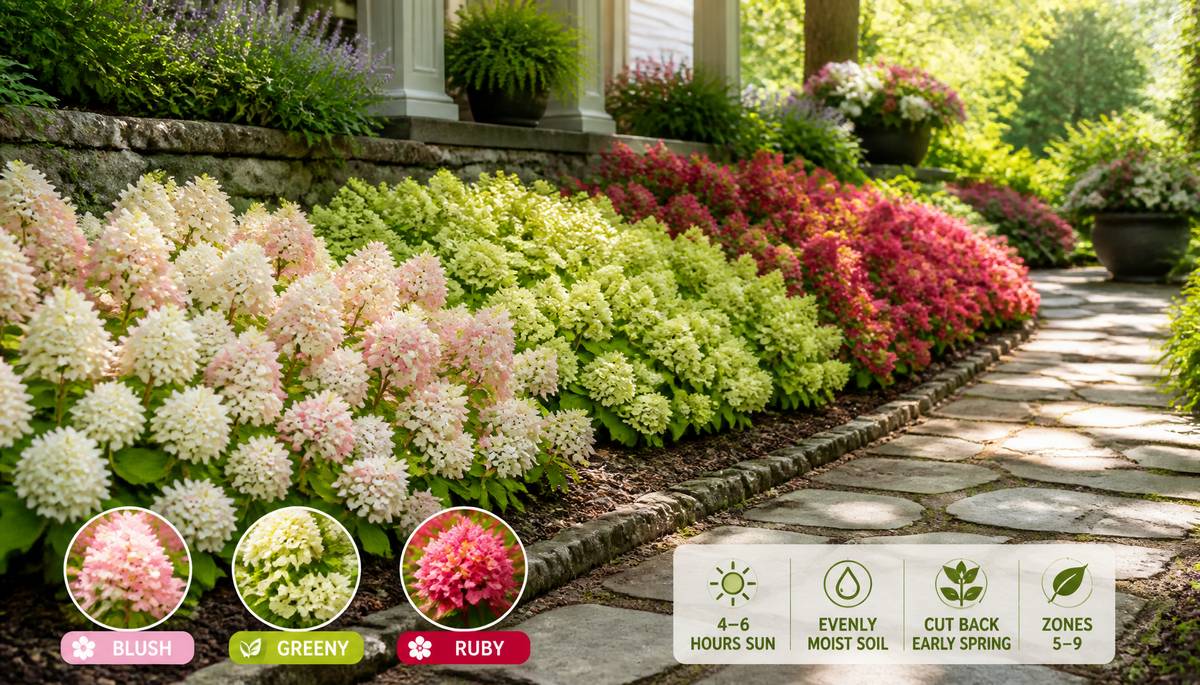 Hydrangeas changing colour is hardly front-page shock. They’ve been doing that for years, quietly and with better manners than most garden trends. The real surprise is that this new lot doesn’t behave like a shrub at all.
Groundbreaker Hydrangeas, newly launched in the US after being bred in the Netherlands by Alex Schoemaker in 2017, stay low and spread wide, forming a flowering groundcover rather than the usual bulky mound. They reach only around 12 to 16 inches tall, but can spread up to 32 inches, producing panicle blooms for as long as 100 days from July into November.
That changes the conversation. Instead of one hydrangea standing there like a puffed-up wedding guest, you get a dense sweep of flowers along a path, at the front of a border, or in a pot. The three cultivars are Blush, which shifts from white to soft pink, Greeny, with lime-green flowers fading creamy white, and Ruby, which starts pale and deepens to red by late summer.
They suit USDA zones 5 to 9, like fertile, well-drained soil that is neutral to slightly acidic, and need about four to six hours of sun, ideally away from harsh afternoon heat. Keep the soil evenly moist, feed in spring, and cut stems back to roughly eight inches in early spring. That’s it. The shock, really, is how practical they are.
Posted on 25 July 2026
Not All Insects Are Vanishing - So Which Ones Are Actually Winning?
 Once, after a summer drive, you had to scrape your windscreen as if buttering toast. Now you can cross half the country and arrive with barely a corpse to show for it. That isn’t just nostalgia talking. Studies across Europe, including the UK, have found real drops in many flying insects.
The losers are often the species that relied on the old patchwork of meadows, hedgerows and wetlands. We’ve tidied, paved and ploughed much of that away. Intensive farming has reduced food and shelter, pesticides have finished off some of what remained, and climate change has started fiddling with the timetable. Add artificial light, pollution and invasive species, and it’s less a single villain than a mob.
But not every insect is heading for the exit. Some are coping perfectly well, even thriving, especially the adaptable generalists that can make do with disturbed habitats and shifting weather. Insect numbers also rise and fall naturally; a warm spring can bring a sudden boom, while a cold, wet one can leave gardens feeling oddly vacant.
So which insects are winning? Usually the flexible ones, not the fussier specialists. That may be good news for them, but it’s not much comfort if fewer moths circle the porch light and fewer butterflies drift past the buddleia. The fix is not glamorous: more native flowers, rougher gardens, restored hedgerows and fewer unnecessary chemicals.
Posted on 15 July 2026
Why Are Home Prices Breaking Records In A Dead Market?
 The housing market is behaving like a car with no fuel somehow rolling uphill.
In June, sales of existing US homes fell 2.4% from May to an annual pace of 4.09 million, below the 4.21 million economists expected. That sounds weak because it is. The market has been stuck near 4 million sales a year since 2023, well under the long-run norm of about 5.2 million. Yet the median sale price still rose 1.8% from a year earlier to $440,600, the highest on records going back to 1999. Prices have now climbed year on year for 36 straight months.
The trick is supply. There were 1.56 million homes on the market at the end of June, only a 4.6-month supply at the current sales pace. A balanced market is usually more like five to six months, and before the pandemic there were roughly 2 million homes for sale. In other words, demand is tired, not dead, and stock is still too thin.
Mortgage rates have not helped. Many June deals were agreed when 30-year rates sat between 6.23% and 6.53%. That freezes out plenty of first-time buyers, who made up 33% of purchases, still below the historic 40%.
There is a wrinkle, though: asking prices are softening in some areas, especially in the West and South. So the market is not healthy. It is merely scarce. Posted on 10 July 2026
Australia’s Luxury Suburbs Are Taking The Hardest Hit
 Australia’s priciest postcodes are discovering an unpleasant truth: prestige is no protection when credit tightens and nerves fray. The sharpest falls are now at the top end, where aspiration has met arithmetic and lost.
In Sydney, the top quarter of the market has shed roughly $90,000 from the median value in just three months. Melbourne and Canberra are also sliding, while in Brisbane, Adelaide and Perth the luxury tier has slowed markedly. Even Hobart, still rising overall, has seen its upper slice reverse. The old glamour has turned a little stale.
This is not just a story about wealthy buyers pausing. The broader market is cooling too. Loan applications in May were down 10.9% on a year earlier, and first-home buyer applications fell 13.4%. June was weaker again at some brokers. Higher rates, with new loans above 6%, have done what sentiment often does not: they have made people stop and think.
Investors are also stepping back from established homes. Lending dropped sharply after tax changes and banks trimmed borrowing power by about 20%. Yet new builds remain an exception, with investor applications for them up 31% year on year.
Meanwhile, auctions are spluttering. Fewer than half are clearing, many homes are selling before the hammer, and withdrawals are rising. Stock is up, urgency is down, and buyers suddenly have the one thing Australian property rarely grants them: choice. Posted on 6 July 2026
The Garden Objects Time Has Already Approved
 New garden décor often feels counterfeit the moment it touches weather. The pieces worth bringing home already bear time’s verdict.
Amanda Thomsen, owner of Aster Gardens in Lemont, Illinois, has spent 25 years pushing gardeners toward stranger, better choices. Her buy-it-now list begins with cast-iron urns, vintage watering cans—including plastic ones from the 1960s through the 1980s—stone troughs, salvaged gates, and old terracotta pots. True antique troughs are scarce; when she cannot find one, she makes concrete or hypertufa versions instead.
She also singles out antique gnomes, wrought-iron plant stands, and 1950s patio furniture in iron, aluminum, or woven vinyl, often with original patterned cushions still turning up cheaply. Dead wheelbarrows become mobile stages for annuals, herbs, or shrubs. Architectural salvage—columns, corbels, finials, stone fragments—adds the illusion of age, even if it may crumble.
Old hand tools earn a second life as wall pieces or bucket-fillers. Vintage peony rings, handmade tomato cages, and other metal supports usually outperform modern equivalents; searching online without the word vintage can keep prices lower. Antique tubs in zinc, galvanized steel, ceramic, or stone work as planters or water gardens; standing water should be treated with BTi, Bacillus thuringiensis israelensis, which kills mosquito larvae without harming plants, pets, or beneficial insects. Thomsen’s current favorite is vintage rolled metal fencing, still undervalued—for now.
Posted on 2 July 2026
When Summer Exposes the Truth About Your Garden
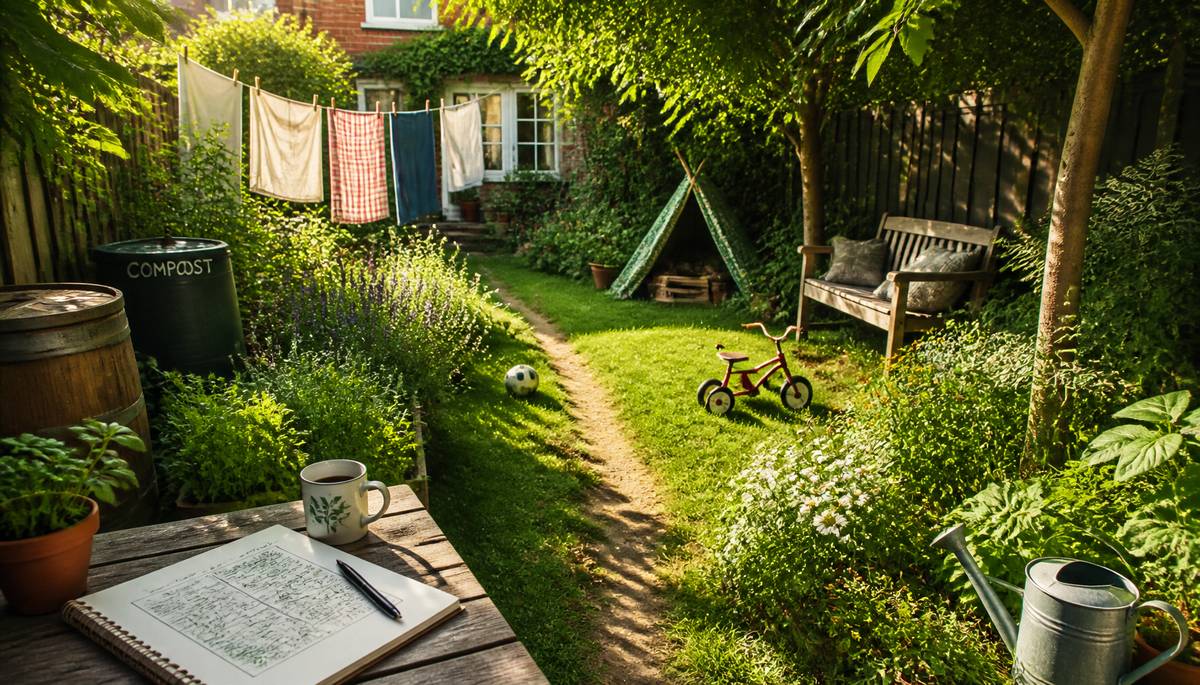 Midsummer is a terrible moment for grand planting fantasies if you actually expect plants to enjoy themselves. It is, however, the season when a garden tells on itself. The light is loud now. You can finally see which corner is a sun-drunk diva and which patch is basically a cave with aspirations.
That makes this stretch after the summer solstice ideal for reconnaissance. Last June, before contracts were even exchanged on a new place, there was already impatience to inspect where the sunlight landed. Access, understandably, was awkward while young renters still lived there. Still, the urge made sense: before changing a garden, you need to watch it.
This one has invited more looking than digging so far. Grass has been allowed to stretch out, a desire path has formed through the middle, laundry has had its little runway moment, and familiarity has slowly replaced urgency.
The real work now is noticing how the space is used. There is no need for an outdoor kitchen for hosts who are bad at barbecuing. What is missing is seating, children’s hideaways and proper shade. Maybe everyone drifts to a tucked-away corner, or maybe eating outside feels too far from the house. Check whether herbs and compost are in sensible places. Sketch the sun’s movement. Save notes, collect ideas, ditch thirsty plants, and consider self-sown volunteers. Then return in September with a plan.
Posted on 28 June 2026
Small Waters, Small Wonders: Why Micro Ponds Are Taking Over Tiny Outdoor Spaces
 A little water can alter the character of a place. This summer, micro ponds—also called patio ponds—have become a favored answer for people with only a courtyard, balcony, or narrow garden to spare. Compact, inexpensive, and notably undemanding, they offer the pleasures of a pond without the excavation, cost, or continual fuss of a full-scale installation.
Their appeal is practical as much as decorative. A small vessel of water can become a miniature habitat, drawing birds, bees, butterflies, and other pollinators into urban spaces while supplying drinking, bathing, and breeding opportunities. The effect is also atmospheric: light on water, a bit of movement, a reflective surface that quiets a corner.
Cherry Lane Garden Centres’ Senior Gardening Buyer, Tom Douglas, notes that their popularity is tied to the wider rise of wildlife-friendly gardening and the wish to support local species without needing a large plot or major expense. Green Feathers expert James Ewens similarly describes patio ponds as stylish, space-efficient, and useful for biodiversity.
Maintenance is modest. In hot weather, top up with fresh water, remove debris, and trim aquatic plants before they dominate. Add a small ramp so wildlife can enter and leave safely. Keep planting restrained, favor oxygenating species, avoid vigorous marginals such as yellow flag iris and bulrushes, and skip fish, whose waste can quickly foul a tiny pond.
Examples include Thompson & Morgan’s Flowering Pond Kit at £24.99 with Anemopsis, Pontederia, and Flag Iris; B&Q’s Patio Pond Kit at £25.99 with pot, plants, basket, and gravel; Crocus’s Pond in a Pot at £139.99 with a 55cm planter, three marginal plants, and a water lily; and Amazon’s Jsdoin Solar Fountain Pump at £12.99.
Posted on 24 June 2026
When London Stopped Being the Sure Bet
 London used to be the sure thing, the gilt-edged bet in Britain’s property racket. If you wanted a house to fatten while you slept, you bought in the capital and waited. That trick has stopped working like it used to.
Rightmove’s latest numbers show London posted the feeblest asking-price growth of any major British city from 2016 to 2026. Over that decade, prices in the capital crawled up 7 per cent, from £639,593 to £687,080, a cash rise of £47,487. It still wears the biggest price tag in the country; it just no longer has the fastest pulse.
Elsewhere, the story has sharper teeth. Manchester and Wolverhampton each logged 63 per cent growth, lifting typical asking prices to £261,891 and £229,094. Newport, Nottingham, Wakefield, Salford and Bradford all cleared 50 per cent. Stoke-on-Trent, Doncaster and Swansea also ranked among the strongest markets.
The reason is plain enough. London spent years outrunning local pay packets, until buyers hit the wall. When prices start high and wages do not, the room for another boom gets cramped.
Hybrid and remote work helped finish the job. Daily access to the capital matters less than it did, so more buyers have swapped nearness for space, lower costs and a calmer life.
This is bigger than housing. Britain’s market is no longer orbiting one city.
Posted on 16 June 2026
The Garden That Forgot Supper
 Once, a garden was a small insurance policy against hunger. It produced beans, apples, mint, onions—things that could be washed, chopped, and eaten before the sun went down. Now, in many suburbs and cities, the garden has become theater. The lawn is clipped like a marine haircut. Shrubs stand in formation. Flowers perform bravely. Dinner still comes from a truck.
People pour thousands into ornamental landscaping while giving little ground to vegetables, herbs, or fruit. It is a curious trick of modern life: we have learned to cultivate admiration more faithfully than nourishment.
Earlier households commonly kept vegetable patches, fruit trees, and herbs as part of ordinary living. Now plenty of people can fuss over a rosebush but have never raised a tomato. Gardening, in many places, has drifted from household skill to lifestyle accessory.
Culture helps this along. Social media prefers a polished border of blossoms to a practical row of potatoes. Garden centers sell what catches the eye. Television and magazines linger on design, not food. So the public imagination fills with petals and empties of peas.
Flowers are not the enemy. Beauty is one of the few decent things we have. But at a time of higher food prices, fragile supply chains, and louder talk of sustainability, it is odd to lavish such care on plants that cannot be eaten. The garden remains. Its purpose has changed. Posted on 9 June 2026
Three Interior Choices That May Be Raising the Temperature in Your Home
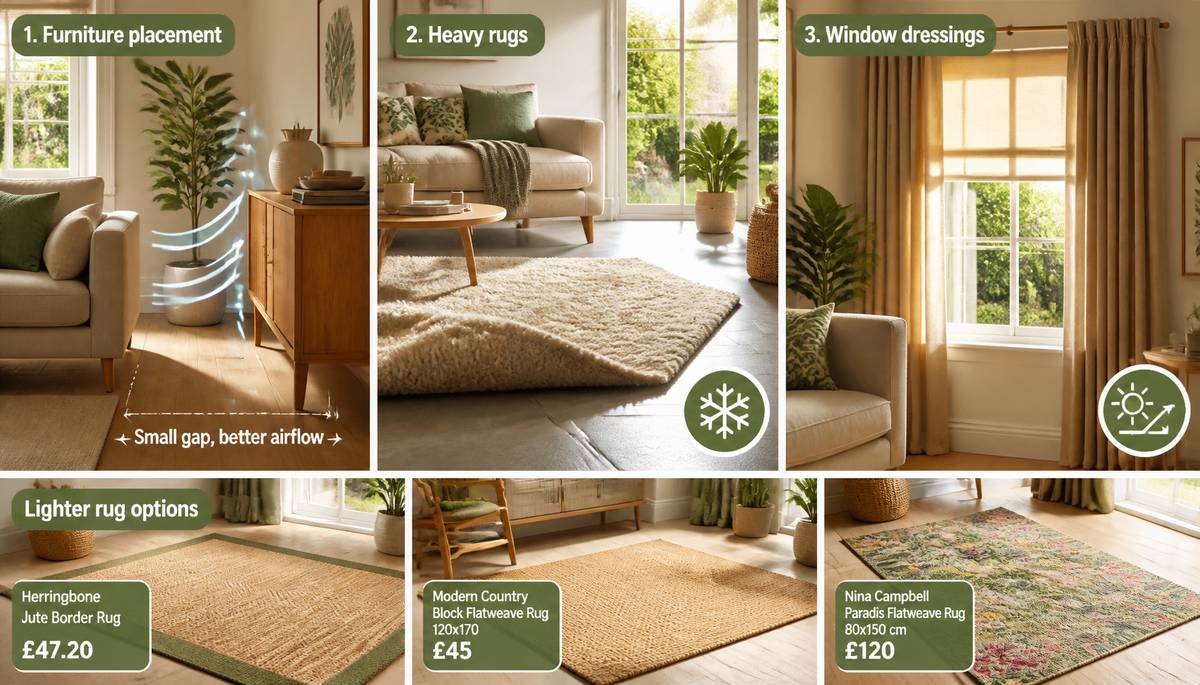 Summer heat in many UK homes is not only a matter of architecture; decor can quietly worsen it. Three common interior choices are especially likely to hinder cooling.
One is furniture placement. Chloe Barrow, Head of Creative and Brand at Laura James, says bulky pieces set hard against walls can impede airflow. Air circulates around cooler surfaces such as walls and floors, so sofas or sideboards pressed tightly in place may create pockets of trapped warmth. Shifting them even a few centimetres can improve movement of fresh air.
A second culprit is the heavy rug. Thick-pile and large area rugs act as insulation, which is useful in winter but less welcome in summer. They also cover hardwood or tiled floors that would otherwise feel cooler underfoot. Barrow recommends lifting heavier rugs for the season, or swapping them for lighter flatweave versions and leaving some busy walkways uncovered.
Window dressings matter too. Blinds, especially thin slatted ones, often admit more sunlight and heat than people expect. Curtains with blackout or thermal linings form a denser shield against the sun and can help keep rooms cooler when closed during the hottest hours.
For those wanting lighter summer flooring, examples include the Herringbone Jute Border Rug at Dunelm for £47.20, Habitat’s Modern Country Block Natural Flatweave Rug, 120x170, for £45, and Next’s Nina Campbell Multi Paradis Flatweave Rug, size 80x150 cm, for £120.
Posted on 2 June 2026
The Suburban Roommate Era Has Arrived
 Roommates used to feel like a city problem: three adults sharing one apartment and one emotionally complicated Brita filter. Now the habit is spreading to the suburbs.
New data from SpareRoom, based on more than 16 million area searches in 2025 compared with 2024, shows a clear rise in people looking for shared housing outside major urban cores. The shift is especially visible across the Sun Belt and in outer parts of New York City, including the Bronx and Coney Island, along with nearby Long Island.
The notable part is that many of these places already have reputations for being less expensive than big-city neighborhoods. Even so, affordability pressures are pushing renters toward shared living.
That lines up with broader economic signals. A CBS News poll found that in April, inflation and overall consumer prices rose slightly faster than incomes for the first time in three years. Rising gas prices were a major factor, and more than three-quarters of respondents said they were worried about their personal finances.
SpareRoom says search trends suggest roommate culture is no longer concentrated in dense urban neighborhoods. Shared housing is becoming a suburban strategy for renters across age groups who are trying to avoid the full cost of living alone.
Among suburban areas, Fort Worth, Texas posted the sharpest jump in roommate searches, up 739 percent from 2024 to 2025. Columbia, South Carolina followed with a 282 percent increase, and Macon, Georgia was next at 259 percent.
Posted on 1 June 2026
Why Permeable Paving Is Poised to Overtake the Traditional Garden Deck
 Garden decking had a nice run: planks, stains, annual regret. Now homeowners are eyeing permeable paving, a surface that does the radical thing of letting rain go where rain used to go before we covered the planet in decorative lids.
The appeal is practical first. Permeable paving is built so water moves through the surface and into the ground instead of skidding off into drains or sitting around as puddles. Olivia Harris, a green infrastructure and stormwater specialist, notes that flexible permeable pavers are gaining favor partly because they cut runoff, especially in flood-prone areas. But the trick only works with the full system: a permeable grid, such as one sold at Home Depot, laid over a permeable base like soil or crushed stone. Catherine Trudeau and Paul Blanding of The Outside Design Studio emphasize that the gaps between pavers are filled with clean, angular stone so water can pass through the whole assembly.
It also solves a design problem. Unlike timber boards, which can look imposed on awkward plots, permeable systems can take curved or custom layouts. Fill the grid with gravel, turf, or bark mulch and the surface blends into the yard instead of interrupting it.
There’s a climate upside too. Dawn De Feo points to less puddling, erosion, and water collecting near the house. Aaron Brundage adds that in drier places, rain is held in the ground rather than lost to storm drains, and the process can lightly filter contaminants.
Posted on 31 May 2026
Before the Lightning Finds the Wires
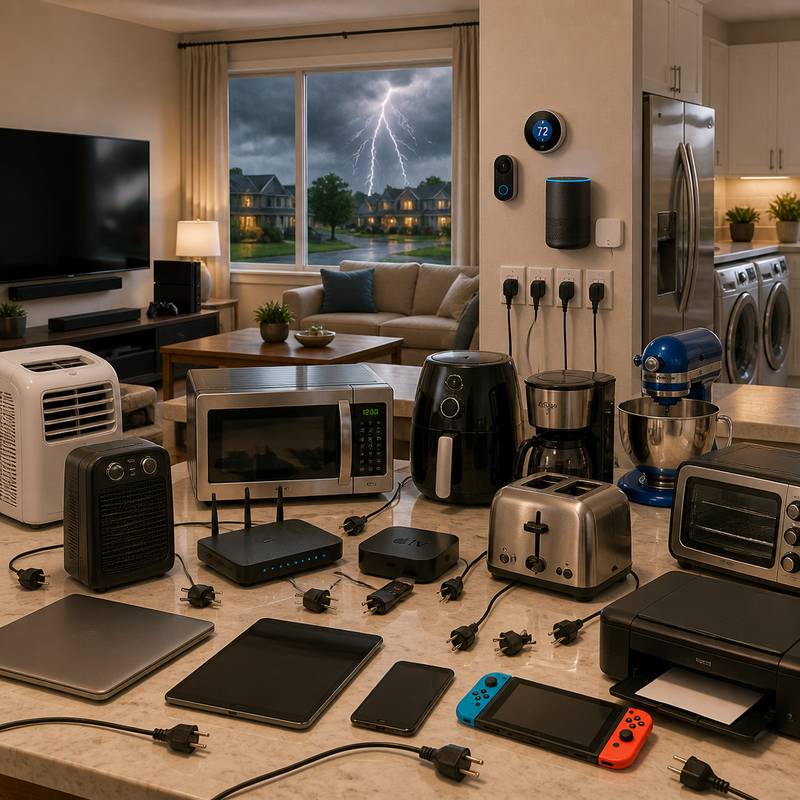 In the South, storm season has a way of arriving all at once: blue sky, then thunder, then the nervous flicker before the lights steady or fail. The real damage is often less visible. A lightning strike, a downed line, even the return of power after an outage can send voltage past normal levels and through a house’s wiring. What suffers first are the small, intricate things: microprocessors, circuit boards, the quiet electronics built into nearly everything now.
Before a storm, the safest move is to disconnect the vulnerable and the expensive. TVs, desktop computers, laptops, gaming consoles, tablets, Wi‑Fi routers, printers, and even phone or laptop chargers are common casualties. Devices do not need to be switched on to be damaged if they remain plugged in.
The same is true of smart-home gear: thermostats, voice assistants, video doorbells, lighting hubs, streaming devices, and security systems. Surges can also travel through cable, internet, and satellite lines.
In the kitchen, smaller appliances such as microwaves, air fryers, coffee makers, toasters, stand mixers, and countertop ovens are at risk. So are space heaters, portable ACs, and window units, whose motors and compressors can be strained when power drops and returns.
Large appliances are somewhat sturdier, though modern refrigerators, washers, dryers, ovens, and dishwashers still contain sensitive controls. Surge protectors help, whole-home systems help more, but in severe thunderstorms unplugging remains the surest defense.
Posted on 29 May 2026
Solar Panels in a Heatwave: Strong Sun, Slightly Weaker Nerves
 Heatwave logic can fool a sane homeowner: blistering sun feels like it ought to supercharge rooftop panels. It doesn’t. Solar panels feed on light, not heat, and once the cells climb much above 25C, efficiency starts to sag.
Most modern panels are engineered to survive roughly -40C to 85C, but they’re happiest nearer that 25C laboratory benchmark. The mechanism is simple and mildly cruel: stronger sun boosts current, yet hotter cells lose voltage, and power depends on both. Result: bright summer weather can still produce excellent output, but extreme heat trims it.
The key number is the temperature coefficient. For every degree above 25C, output typically slips by about 0.34 to 0.5 percentage points. Using Britain’s record 40.3C on 19 July 2022 as a rough guide, that suggests a good panel might run about 5 per cent below its optimum rating. Panels themselves can get hotter than the air, but even near 85C the reduction is usually around 20 per cent versus standard test conditions, not a 20 per cent collapse in yearly yield.
Another weak link is the inverter, which can throttle in hot, badly ventilated spaces such as lofts.
Even so, on 19 July 2022, Sheffield Solar’s PV Live estimates showed solar generating 66.9GWh, covering about 8.6 per cent of UK electricity demand; over the previous week, it supplied around 9 per cent.
Posted on 27 May 2026
Why Rock Gardens Keep Coming Back
 Rock gardens are back again, which feels reassuring. In a world that keeps trying to sell us novelty, here comes a landscaping idea that has already survived multiple comebacks. Rockeries surged in the 1920s, faded for about 40 years, returned in the 1960s, and have now rolled firmly into the 21st century.
The timing makes sense. Much of North America is in drought, and xeriscaping has shifted from niche virtue to practical necessity. A garden built around stone and tough, drought-tolerant plants uses less water and generally asks less of its owner than a traditional flower bed forever pleading to be deadheaded, watered, or rescued.
That restraint is part of the appeal, but not all of it. Designers in 2026 are highlighting rock gardens for their year-round structure: even in January, when ordinary beds can look bereaved, a rock garden still has shape and presence. There is also room for invention. The format can be as spare as a place to display a favorite stone collection or as elaborate as a sensory landscape for children.
Landscape designer Gerardo Loayza of Bacqyard, gardening expert Irvin Etienne of Newfields, and Instagram grower Misilla dela Llana have all pointed to the same core strengths: strong seasonal form, creative flexibility, low upkeep, and reduced water use. In other words, the old rockery has returned because it still knows how to behave. Posted on 25 May 2026
The Summer Truce: Keeping Wasps at a Safe Distance
 Wasps are the small, bright mechanics of summer: pollinators, hunters of caterpillars, stink bugs, flies, even spiders. Most are not looking for war with people. Trouble begins only when a colony fastens its paper city to a porch light, wall void, grill, shrub, attic, or patch of ground near daily life.
Mike Raupp, Ph.D., University of Maryland professor emeritus of entomology and extension specialist, notes that solitary wasps are largely non-aggressive. The real risks come from social species. Yellowjackets are the chief menace, with late-summer colonies swelling into the thousands; they nest in soil, walls, and behind siding, sting repeatedly, and grow fiercest in fall. European hornets, common in the South, build tan paper nests in hollow trees, walls, and attics and are drawn to lights at night. Paper wasps use sheltered spots such as shutters, mailboxes, doorways, and porch lights. Bald-faced hornets build football-shaped nests in shrubs, trees, and on buildings. Mud daubers rarely sting.
Frequent sightings, buzzing indoors, dead wasps inside, visible nests, or wood damage can signal trouble. Sydney Crawley, Ph.D., North Carolina State University, recommends prevention: cover meat, fruit, sweets, and drinks; use lidded cups instead of soda cans; clean and cover trash; pick up fallen produce; seal eaves, siding gaps, doors, windows, and screens; move compost away; fill ground holes; destroy small spring nests early.
Essential oils, decoy nests, traps, and soapy water offer limited help. For necessary removal, treat nests at evening with an aerosol spray reaching 10 feet or more, then stay away a day. Leave low-traffic nests alone. Call professionals for allergies, wall nests, aerial nests, large infestations, difficult access, or uncertain identification. Queens may live up to a year; workers and drones about two to three weeks. Posted on 24 May 2026
How to Make a Small Home Think Bigger
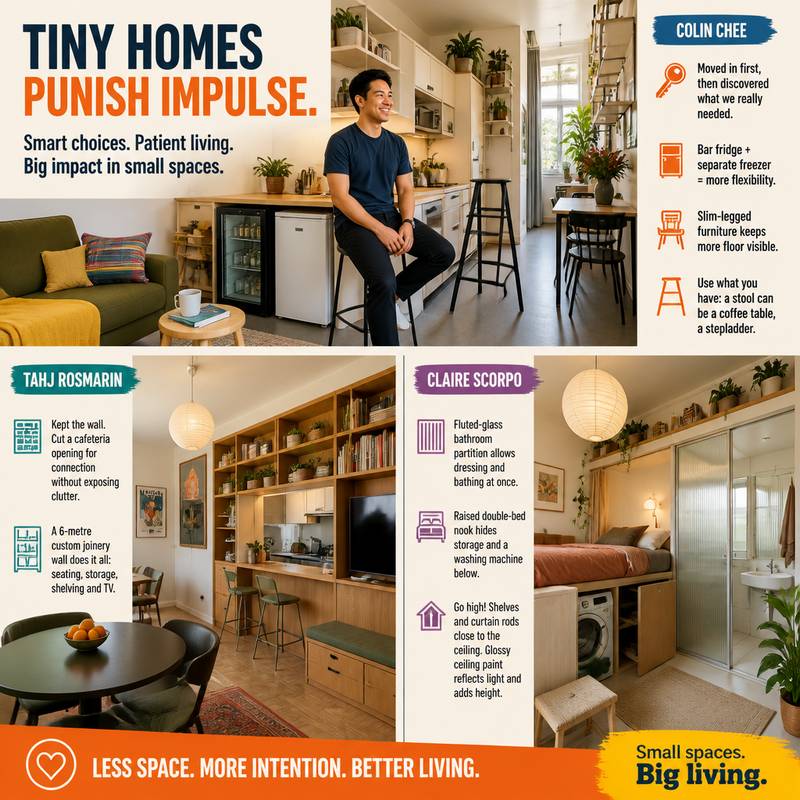 Tiny homes punish impulse. Colin Chee learnt that in 2010, when he collected the keys to a 37 sq m off-the-plan flat in central Melbourne and discovered, too late, how badly it worked. That frustration eventually became Never Too Small, the YouTube channel he launched in 2017, now followed by more than 3 million subscribers.
With apartment living rising, Chee, Claire Scorpo of Agius Scorpo Architects, and Tahj Rosmarin of Card Practice will speak at the National Gallery of Victoria this weekend at Small Spaces, Big Living.
Their shared lesson is that compact homes need patience, not panic-buying. Chee, now in a 40 sq m converted warehouse with his partner, spent about $5,000 on secondhand pieces and Ikea and Bunnings systems. He recommends moving in first, then discovering what the rooms actually need. In his kitchen, a bar fridge and separate small freezer replace a single bulky unit; slim-legged furniture keeps more floor visible; a stool can stand in for a coffee table and a stepladder.
Rosmarin’s North Melbourne walk-up resists the usual open-plan reflex. Instead of removing a load-bearing wall, he and his partner cut a cafeteria-style opening between kitchen and living room: connection without exposing clutter. A six-metre custom joinery wall, costing about $5,000, handles seating, storage, shelving and TV.
In Fitzroy’s Cairo block, Scorpo and her husband reworked a poorly renovated 23 sq m bedsit. A fluted-glass bathroom partition allows dressing and bathing at once. Their raised double-bed nook hides storage and a washing machine below. Chee adds that even ordinary apartments can feel taller by pushing shelves and curtain rods close to the ceiling and using glossy ceiling paint. Posted on 22 May 2026
Two Winters, Two Systems
 Postwar Britain and Sweden made opposite bets on how homes should feel in winter, and the bill is still arriving.
In the UK, roughly 6 million households cannot reliably afford to keep warm. Homes are often badly insulated, heavily tied to natural gas, exposed to price shocks, and associated with excess winter deaths. Sweden, though markedly colder, keeps homes warmer at lower relative strain and records far fewer cold-related winter deaths.
The split began after 1945. In Britain, the urgent problem was coal smoke, sharpened by the 1952 Great Smog. When North Sea gas was discovered in 1965, the country moved hard toward gas central heating, selling it as cleaner, simpler, more modern than coal. By the 1970s, gas was built into domestic life.
Sweden attached heating to folkhem, “the people’s home,” where decent housing was part of collective welfare. Through the 1960s and 1970s, cities expanded district-heating systems, and “warm rent” commonly folded heating into the rent itself. At the same time, Sweden spread risk across hydropower, nuclear, biomass, waste-fuel heating, insulation and broader efficiency measures.
Then the 1970s oil crisis hit. Sweden doubled down on efficiency and energy independence. Britain stayed more exposed to fossil fuels, endured power cuts, and left many homes thermally weak. After 2010, UK efficiency efforts were further slowed as programmes were rolled back.
The result: Sweden largely “futureproofed” heating. Britain’s gas habit now drives both climate pressure and unaffordable warmth, even as both countries confront the new strains of electrification and heat pumps.
Posted on 20 May 2026
Monaco Penthouse Sets New Record at Over $500 Million
 There are extravagances which, if they do not invite admiration, at least compel attention; and Monaco, that diminutive principality of immense prices, has now furnished one of the grandest. In one of its most coveted districts, a 21-room penthouse in Le Renzo has changed hands for €471 million, or about $554 million, establishing the highest residential sale yet recorded.
The buyer was System Capital Management (SCM), the holding company of Ukrainian billionaire Rinat Akhmetov. The residence crowns the waterfront building across five levels, extending over more than 26,900 square feet. Its inducements are as lavish as one might expect: eight private parking spaces, terraces opening directly upon the Mediterranean, a pool, a jacuzzi, top-tier interiors, and the latest home-automation systems.
Its astonishing price is less a whim than the consequence of several converging advantages. Monaco, second only to the Vatican in sovereign smallness, has for some time commanded exceptional housing values; last year, estimates placed prices above €70,000 ($82,300) per square metre. Le Renzo itself is singular, being the first project in decades to alter the principality’s skyline. The penthouse, moreover, is arranged less like a flat than a five-storey villa suspended above the sea.
The purchase comfortably surpasses prior benchmarks: Nick Candy’s London mansion at over $350 million and Ken Griffin’s New York penthouse at roughly $240 million. Experts take the sale as further proof that the ultra-luxury property market is still advancing.
Posted on 17 May 2026
homeandgardenlistings.co.uk (c)2009 - 2026